header
News
Pioneering Personalized Therapies for Medulloblastoma
DATE 2026-09-07 13:44:19.0
- WRITER 학무부총장실
Medulloblastoma reclassified into seven distinct subgroups via integrated proteogenomics
Paves the way for improved prognostic prediction and subgroup-specific targeted therapies
Paves the way for improved prognostic prediction and subgroup-specific targeted therapies
A research team led by Professor Jong Bae Park of the Department of Medicine has demonstrated new potential for predicting patient-specific prognoses and developing tailored therapeutic strategies for medulloblastoma—the most common malignant pediatric brain tumor—through integrated proteogenomic analysis. The collaborative study brought together researchers from Seoul National University, the Korea Brain Research Institute (KBRI), Korea University, Kookmin University, and the University of Ulsan.
Medulloblastoma is a leading pediatric malignancy of the central nervous system. Although current standard-of-care protocols combine surgical resection with adjuvant radiotherapy and chemotherapy, these aggressive interventions often leave severe, lifelong sequelae in developing children. Furthermore, recurrent cases carry a particularly poor clinical prognosis. Because tumor biology, therapeutic response, and clinical outcomes vary markedly among patients within the same broad diagnosis, establishing a more granular classification framework and targeted treatment strategies is critical.
“While molecular classifications such as WNT, SHH, Group 3, and Group 4 have been widely used, they possess limitations in fully explaining actual patient prognoses, recurrences, and treatment responses,” explained Professor Park. “We believed that analyzing proteins and phosphorylation signaling—which carry out actual cellular functions—beyond the genomic and transcriptomic (RNA) levels would allow us to identify clinically more meaningful subgroups and therapeutic targets.”
Highlighting the primary breakthrough, Professor Park noted: "The core value of this study is not merely creating finer taxonomic labels, but establishing that each subgroup exhibits distinct oncogenic biology, clinical prognoses, and therapeutic vulnerabilities." The team revealed substantial intra-entity heterogeneity: while some patients displayed differentiated neuronal phenotypes associated with favorable outcomes, others exhibited heightened cell-cycle progression, epithelial-mesenchymal transition (EMT), and aberrant kinase signaling, driving significantly more aggressive tumor phenotypes.
Specifically, the SHHβ and G4γ subgroups exhibited more differentiated neuronal signatures, which strongly correlated with favorable clinical outcomes. These findings provide an actionable framework for future risk stratification and treatment de-escalation or intensification. For patients presenting with favorable-prognosis subtypes, clinicians can de-escalate aggressive therapies to spare developing children from long-term treatment-related toxicities. Conversely, for individuals harboring biologically high-risk profiles, clinicians can deploy intensified frontline interventions and precision targeted therapies from diagnosis.
Moving forward, the research team plans to validate these seven molecular subgroups alongside identified proteomic and phosphoproteomic biomarkers across expanded, multi-center patient cohorts. They also aim to translate their findings into clinical-grade diagnostic panels and advance targeted therapeutics and drug repurposing strategies for high-risk subgroups—such as SHHα and G4α—into preclinical models and clinical trials. In parallel, the team will dissect the molecular mechanisms driving upregulated EMT and cell-cycle signaling cascades in recurrent tumors, with the goal of establishing therapeutic interventions that predict and suppress tumor recurrence at an early stage.
This breakthrough marks a milestone in cancer proteogenomics-driven precision medicine led by the National Cancer Center's Cancer Proteogenomics Research Consortium, supported by the Lee Kun-hee Pediatric Cancer and Rare Disease Support Initiative. The findings were published in the June issue of the international journal Experimental & Molecular Medicine (IF: 17.5).
Medulloblastoma is a leading pediatric malignancy of the central nervous system. Although current standard-of-care protocols combine surgical resection with adjuvant radiotherapy and chemotherapy, these aggressive interventions often leave severe, lifelong sequelae in developing children. Furthermore, recurrent cases carry a particularly poor clinical prognosis. Because tumor biology, therapeutic response, and clinical outcomes vary markedly among patients within the same broad diagnosis, establishing a more granular classification framework and targeted treatment strategies is critical.
“While molecular classifications such as WNT, SHH, Group 3, and Group 4 have been widely used, they possess limitations in fully explaining actual patient prognoses, recurrences, and treatment responses,” explained Professor Park. “We believed that analyzing proteins and phosphorylation signaling—which carry out actual cellular functions—beyond the genomic and transcriptomic (RNA) levels would allow us to identify clinically more meaningful subgroups and therapeutic targets.”
Reclassifying Medulloblastoma into Seven Molecular Subgroups
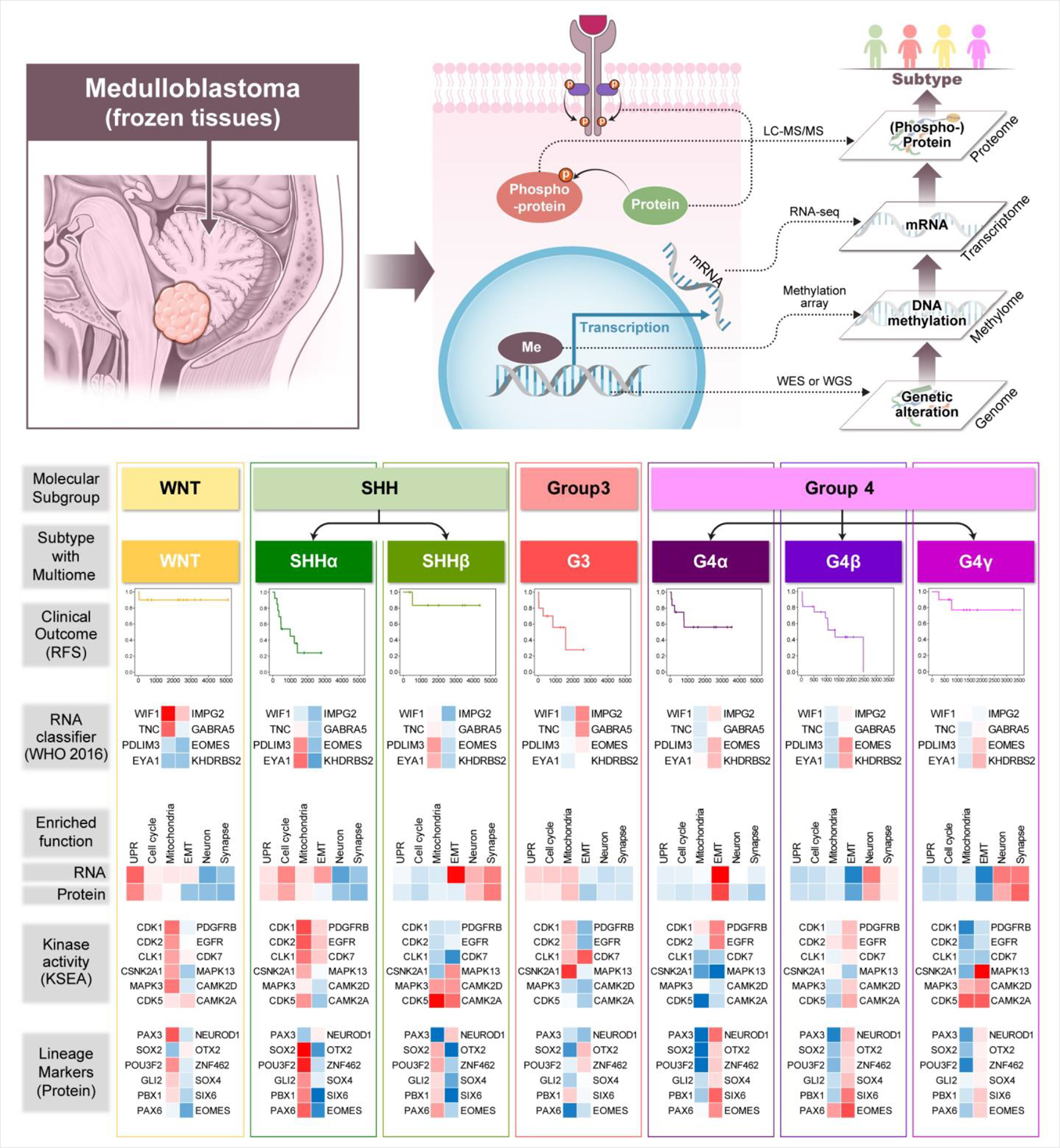
To achieve this, the research team integrated multi-omics datasets across five analytical platforms, including liquid chromatography–tandem mass spectrometry (LC-MS/MS) for comprehensive proteomic and phosphoproteomic profiling. Leveraging this multi-layered dataset, they reclassified medulloblastoma into seven granular subgroups, refining the conventional four-group consensus. Specifically, they stratified the classic SHH subgroup into SHHα and SHHβ, and subdivided Group 4 into G4α, G4β, and G4γ.Highlighting the primary breakthrough, Professor Park noted: "The core value of this study is not merely creating finer taxonomic labels, but establishing that each subgroup exhibits distinct oncogenic biology, clinical prognoses, and therapeutic vulnerabilities." The team revealed substantial intra-entity heterogeneity: while some patients displayed differentiated neuronal phenotypes associated with favorable outcomes, others exhibited heightened cell-cycle progression, epithelial-mesenchymal transition (EMT), and aberrant kinase signaling, driving significantly more aggressive tumor phenotypes.
Specifically, the SHHβ and G4γ subgroups exhibited more differentiated neuronal signatures, which strongly correlated with favorable clinical outcomes. These findings provide an actionable framework for future risk stratification and treatment de-escalation or intensification. For patients presenting with favorable-prognosis subtypes, clinicians can de-escalate aggressive therapies to spare developing children from long-term treatment-related toxicities. Conversely, for individuals harboring biologically high-risk profiles, clinicians can deploy intensified frontline interventions and precision targeted therapies from diagnosis.
Overview of the integrated proteogenomic analysis workflow for medulloblastoma. By integrating multi-omics datasets across five analytical platforms, the research team reclassified medulloblastoma into seven distinct subgroups, delineating subgroup-specific clinical prognoses and actionable therapeutic vulnerabilities.
Paving the Way for Precision Oncology in Pediatric Brain Cancer
In pediatric neuro-oncology, therapeutic success is defined not only by improving overall survival rates, but also by preserving survivors' long-term quality of life. This study establishes a rigorous molecular rationale to evaluate patient prognoses, assess recurrence risks, and determine candidacy for targeted therapies with unprecedented precision. "Over the long term, these findings will inform precision oncology strategies that allow clinicians to de-escalate treatment intensity in low-risk patients while deploying tailored targeted agents for high-risk cohorts," noted Professor Park.Moving forward, the research team plans to validate these seven molecular subgroups alongside identified proteomic and phosphoproteomic biomarkers across expanded, multi-center patient cohorts. They also aim to translate their findings into clinical-grade diagnostic panels and advance targeted therapeutics and drug repurposing strategies for high-risk subgroups—such as SHHα and G4α—into preclinical models and clinical trials. In parallel, the team will dissect the molecular mechanisms driving upregulated EMT and cell-cycle signaling cascades in recurrent tumors, with the goal of establishing therapeutic interventions that predict and suppress tumor recurrence at an early stage.
This breakthrough marks a milestone in cancer proteogenomics-driven precision medicine led by the National Cancer Center's Cancer Proteogenomics Research Consortium, supported by the Lee Kun-hee Pediatric Cancer and Rare Disease Support Initiative. The findings were published in the June issue of the international journal Experimental & Molecular Medicine (IF: 17.5).