header
News
Unveiling Life Expectancy Drivers: Professor Dong Keon Yon’s Team Publishes Study in Nature
DATE 2026-09-07 13:43:11.0
- WRITER 학무부총장실

A research team led by Professor Dong Keon Yon published a landmark study in Nature tracking life expectancy across 34 Asian countries from 1990 to 2023. The global collaboration engaged over 900 researchers from Harvard Medical School, the Gates Foundation, IHME, Korea University, and Yonsei University. Pictured from left: Professor Dong Keon Yon and lead author Hyunjin Kim.
Research team conducts the world’s first long-term tracking study on life expectancy in 34 Asian countries
Asia sees a general rise in life expectancy over three decades, but COVID-19 and chronic diseases slow down progress
A study led by Professor Dong Keon Yon of the College of Medicine was published in the international journal Nature (IF: 56.1). Titled "Mapping drivers of life expectancy change in Asia from 1990 to 2023," the paper comprehensively evaluates regional longevity trends alongside key disease burdens and risk factors over a 33-year period. First author Hyunjin Kim of the Digital Health Center led the initiative within a global consortium of over 900 researchers, collaborating with teams from Korea University (Prof. Ji Seung Kang), Yonsei University (Prof. Jae Il Shin), the Institute for Health Metrics and Evaluation (IHME) at the University of Washington, the Gates Foundation, and Harvard Medical School.
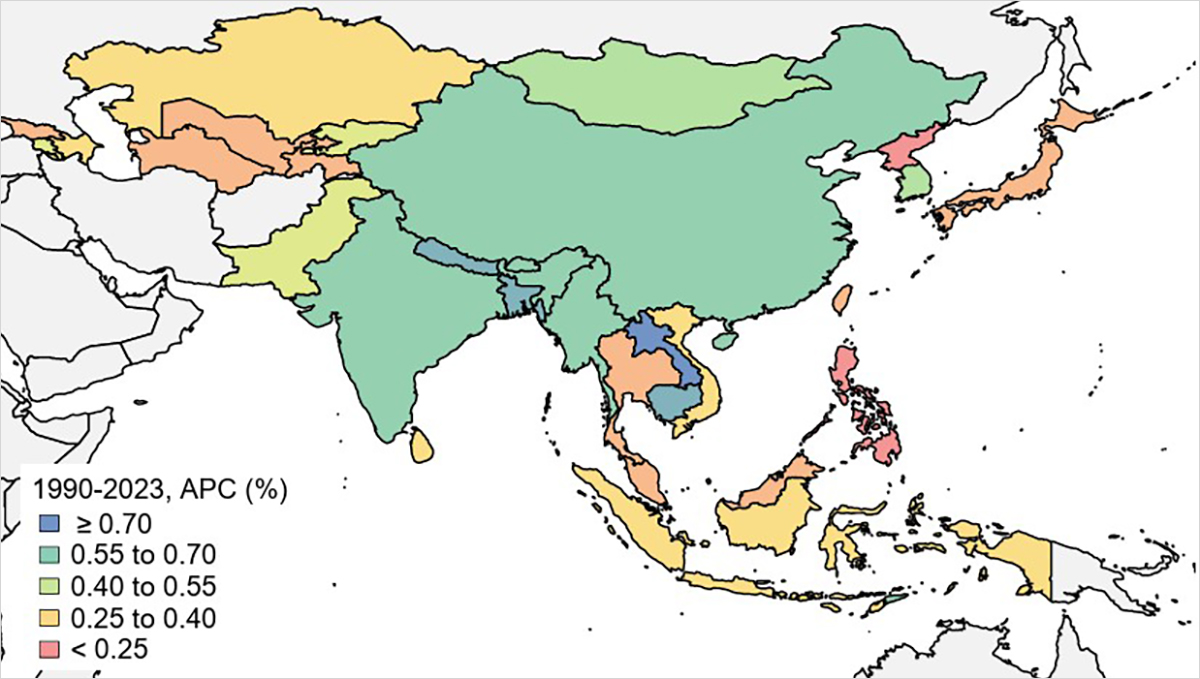
Chart illustrating changes in life expectancy at birth across 34 Asian countries from 1990 to 2023. Values for each country are presented as the Annual Percentage Change (APC), representing the average annual increase or decrease in life expectancy during the period. Higher values indicate more rapid improvements in life expectancy.
Rapid Gains in South Asia, Highest Longevity in High-Income Asia-Pacific
According to the research team, life expectancy across Asia has risen broadly over the past three decades. South Asia saw the most dramatic progress, climbing 12.6 years from 58.6 in 1990 to 71.2 in 2023. Meanwhile, the high-income Asia-Pacific region—which includes South Korea and Japan—maintained the highest life expectancy across the continent, increasing from 77.5 to 84.1 years over the same timeframe. Across all Asian subregions, female life expectancy consistently outpaced that of males; by 2023, life expectancy in the high-income Asia-Pacific reached 87.1 years for females and 81.0 years for males.The drivers behind these longevity gains varied considerably by region. In Central and East Asia, as well as the high-income Asia-Pacific, medical advancements in cardiovascular therapies (such as treatments for stroke and ischemic heart disease) and expanded healthcare access were pivotal in extending lifespans. Conversely, in South and Southeast Asia, broader vaccination coverage along with investments in clean drinking water and sanitation sharply reduced mortality from diarrheal illnesses, lower respiratory infections, and tuberculosis, driving the region's overall life expectancy gains.
However, the COVID-19 pandemic between 2019 and 2023 adversely affected the upward trend of life expectancy in Asia. The study revealed a decrease in life expectancy of about 0.327 years in Southeast Asia and about 0.275 years in East Asia. Along with the pandemic, the researchers identified hypertension, unhealthy diets, and air pollution as key risk factors negatively affecting life expectancy in Asia. Chronic disease-related risk factors, such as hypertension and high fasting plasma glucose, have steadily increased over the past 30 years in Central, East, and South Asia, pointing to them as priority targets for future public health policies.
“Over the past 30 years, public health standards in Asia have generally improved significantly. However, life expectancy inequality driven by economic disparities among regions and countries remains severe,” Professor Dong Keon Yon, who led the research, stated. “Low-income countries with vulnerable healthcare infrastructure require supplies of essential medicines and expansions of sanitation and vaccine programs. Meanwhile, high-income nations like South Korea and areas with rising chronic illnesses must strengthen prevention-oriented, customized health policies, including hypertension management, smoking cessation, and air quality improvements.”
“This research comprehensively analyzes changes in life expectancy across Asia, which is home to about 60% of the global population,” researcher Hyunjin Kim explained. “By closely examining the specific diseases and risk factors that influenced these changes at regional and national levels, this study will serve as a vital scientific foundation for future policymaking by health authorities across Asian nations.”