header
News
Professor Jinseok Lee Honored with Presidential Commendation for Leading Medical AI Innovation
DATE 2026-07-22 10:02:50.0
- WRITER 학무부총장실
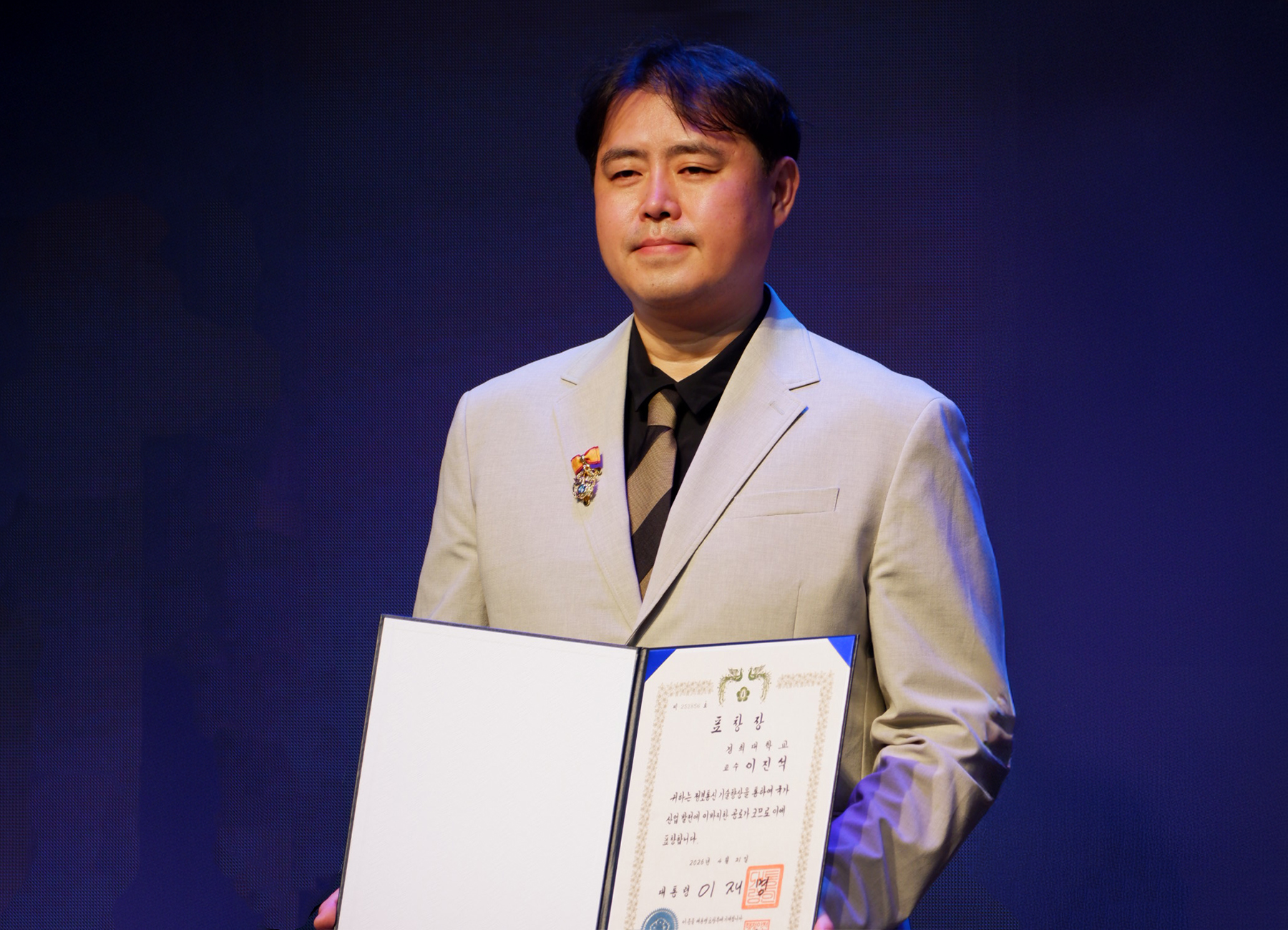
Professor Jinseok Lee of the Department of Biomedical Engineering received the Presidential Citation on Science and ICT Day in recognition of his contributions to building research infrastructure and fostering talent in medical AI.
Developing core multimodal AI technology, leading global research collaboration
"Aiming to secure international credibility for Korea's AI research outcomes"
Professor Jinseok Lee of the Department of Biomedical Engineering received the Presidential Citation on Science and ICT Day in recognition of his achievements in establishing research infrastructure and nurturing outstanding talents in the field of medical artificial intelligence. Professor Lee is leading innovations in emergency medicine by driving the development of core multimodal artificial intelligence technologies.
Establishing a Korea-Led Global AI Research Platform
Professor Lee is leading research into core multimodal AI technology, which integrates and analyzes diverse data sources including biosignals, medical imaging, and clinical text. Unlike traditional systems that rely on a single format, this AI simultaneously interprets multiple data types. As a result, Professor Lee serves as the principal investigator for several major national strategic AI initiatives.Through the Information Technology Research Center (ITRC) program—funded by the Ministry of Science and ICT and managed by the Institute for Information & Communications Technology Planning & Evaluation (IITP)—he oversees the architecture for a end-to-end AI system spanning data collection, transmission, analysis, and clinical decision-making. He is also driving the development of core algorithms and data-processing technologies tailored for real-world medical use. "In emergency situations, medical teams are flooded with different physiological datasets all at once," Professor Lee explained. "An AI capable of synthesizing this data to make rapid, accurate decisions will be a true game-changer for emergency medicine."
Professor Lee is also driving international research collaboration in medical AI far beyond Korea. As principal investigator of the 'Global AI Frontier Lab,' he is establishing a global AI research hub in partnership with New York University (NYU)—a structure led by Korean researchers and joined by leading international institutions.
This collaboration is already yielding tangible results. The research team established a multinational network involving eight regional trauma centers in Korea (including Ajou University Hospital and Chonnam National University Hospital), the NYU Langone Trauma Center in the US, and the Westmead Trauma Center in Australia. Together, they developed an AI model that predicts a trauma patient's mortality risk in real time during pre-hospital transport, validating its performance using multi-center datasets from Korea and abroad. "This is a prime example of AI technology developed in Korea being directly validated and reproduced in international clinical settings," Professor Lee emphasized. "It plays a major role in elevating the global credibility and competitiveness of Korean AI research."
Fostering AI Talent and Expanding Educational Horizons
Breakthroughs at Professor Lee’s laboratory are rapidly making their way into industry. Over the past five years, his work has yielded 16 domestic patent applications, four registrations, and seven international patent applications. Beyond intellectual property, his team's research is actively driving real-world commercialization through tech transfer initiatives.In addition to building cutting-edge research infrastructure, Professor Lee is deeply committed to training the next generation of AI specialists. Through the Global AI Frontier Lab, he dispatches young researchers to top international institutions, including NYU. He also serves as Deputy Director of the 'Medical AI Convergence Talent Support Project,' sponsored by the Ministry of Health and Welfare. This strategic national program bridges healthcare and artificial intelligence to foster global competitiveness. To make an immediate impact, Professor Lee designed a cross-disciplinary curriculum that enables engineering students to grasp clinical realities and healthcare needs, empowering them to build and deploy medical AI solutions directly.