header
News
Empowering New Faculty for Teaching Excellence
DATE 2026-05-18 13:57:39.0
- WRITER 학무부총장실
‘KHU-PREP’ program strengthens new faculty teaching capabilities through standardized pedagogical methods to elevate overall educational quality
Kyung Hee University implements KHU-PREP (Professional Readiness & Enhancement Program), a mandatory pedagogical initiative designed to strengthen the teaching competencies of new faculty members.Targeting newly appointed faculty members with limited full-time teaching experience at a four-year institution, the program helps educators master Kyung Hee’s unique, standardized pedagogical methods to elevate the overall quality of student education. Completion is required within the first two semesters of appointment, serving as a prerequisite for reappointment. While the Offices of Academic Affairs on both campuses established the institutional foundation for the program, the Center for Teaching and Learning (CTL) spearheaded its design and operational execution.
The Transition from Researcher to Educator
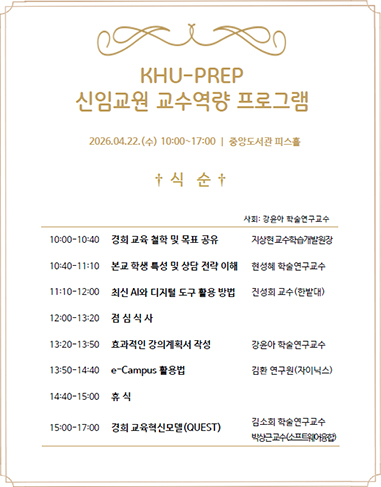
The KHU-PREP program took place across both campuses over two days, Tuesday, April 21, to Wednesday, April 22. Designed to boost the “teaching self-efficacy” of new faculty members, the initiative aims to institutionalize a high level ofl standardized educational quality. A primary focus was ensuring that new educators internalize Kyung Hee’s core educational philosophy and its proprietary innovation model, “QUEST,” at the very start of their tenure to maintain institutional consistency. The curriculum featured practical sessions focused on essential teaching capabilities, including understanding learner characteristics, effective instructional design, and leveraging educational technology (edtech).Sang-Hyun Chi, Director of the CTL, introduced Kyung Hee’s educational vision while candidly addressing the real-world challenges new faculty face when leading their first courses. Having dedicated years primarily to research , many newly appointed professors step up to the podium with limited experience in syllabus design, learner engagement, and assessment methods. Furthermore, the higher education landscape is rapidly evolving with the integration of AI and the expansion of flexible major systems, resulting in a more diverse student body. Highlighting Kyung Hee’s core values—excellence, creativity, empathy, and communication—Director Chi urged the attendees, “I hope you will cultivate your own teaching philosophy within the framework of Kyung Hee’s educational vision.”
Sang-Hyun Chi, Director of the CTL, introduced Kyung Hee’s educational vision while candidly addressing the real-world challenges new faculty face when leading their first courses. Having dedicated years primarily to research , many newly appointed professors step up to the podium with limited experience in syllabus design, learner engagement, and assessment methods. Furthermore, the higher education landscape is rapidly evolving with the integration of AI and the expansion of flexible major systems, resulting in a more diverse student body. Highlighting Kyung Hee’s core values—excellence, creativity, empathy, and communication—Director Chi urged the attendees, “I hope you will cultivate your own teaching philosophy within the framework of Kyung Hee’s educational vision.”
· Identifying personal teaching styles and establishing a stable classroom environment.
· Designing effective, comprehensive, and engaging syllabi.
· Understanding student demographics and developing target academic counseling strategies.
· Setting clear instructional policies regarding attendance, assessments, and AI utilization.
· Navigating available CTL support services, including individual consulting, seminars, and edtech assistance.
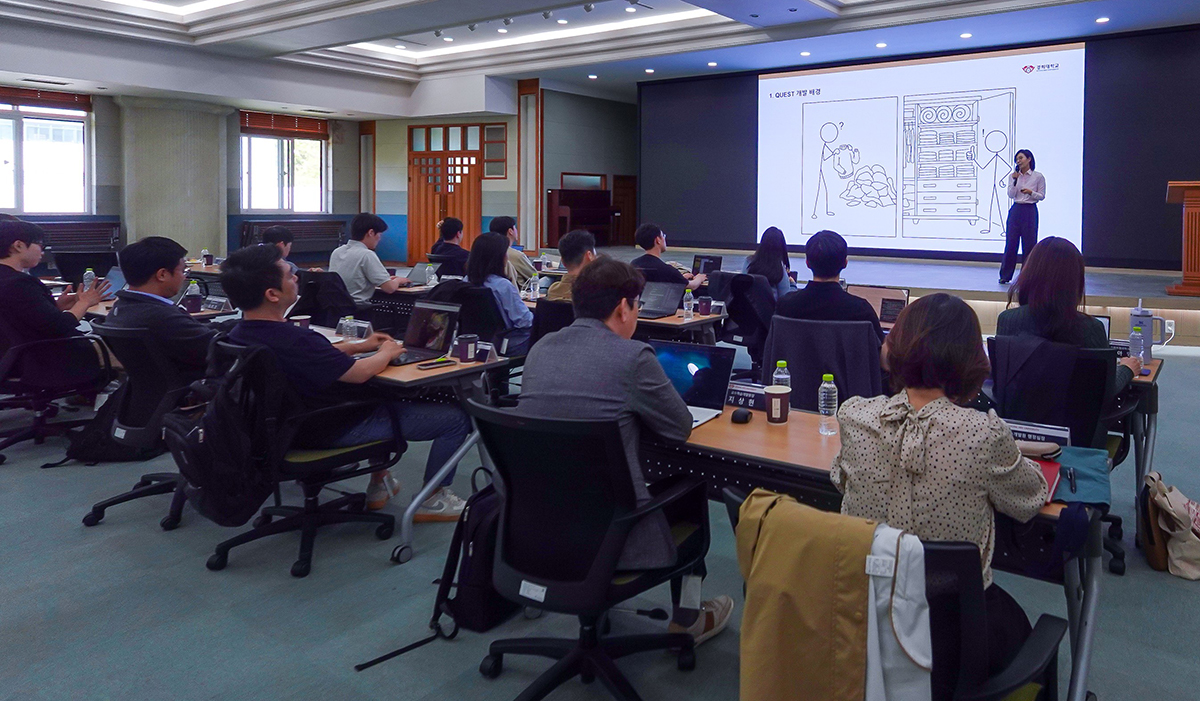
The sessions also introduced QUEST, Kyung Hee’s signature educational innovation model, which was developed to address challenges in student engagement. QUEST is designed to be easily implemented by instructors and expanded in stages.
Establishing Teaching Standards with the QUEST Model
The sessions concluded with a detailed introduction to QUEST, Kyung Hee’s signature educational innovation model. An acronym for “Quantum Leap: Understand, Engage, Share, reThink,” QUEST is a teaching model designed with a four-stage circular structure:1. Understand: Internalizing educational content.
2. Engage: Applying knowledge and expanding experience through active participation and immersion.
3. Share: Presenting and communicating findings to facilitate mutual learning.
4. reThink: Reflecting on and reconstructing the overall learning experience.
Developed to address common classroom challenges such as declining student engagement and a lack of interaction, QUEST is designed to be easily implemented by instructors and expanded in phases. It features specific sub-models for four types of instruction: Theory, Task/Problem, Experiment, and Capstone. During a pilot run across six courses in the second semester of 2025, the model led to significant improvements in students’ problem-solving skills and edtech competencies. For faculty, it provided a clear benchmark for systematically reflecting on and improving their teaching methodologies.
Professor Sangkeun Park (Department of Software Convergence) shared insights from his Web/Python Programming course, a mandatory major requirement for first year students. He used Slido quizzes to check comprehension in every session and encouraged students to apply concepts through practical projects like data analysis and website creation. While he encouraged the use of generative AI as a tool for project execution, he emphasized the importance of students setting their own directions and critically reviewing AI-generated results.
The program also featured case studies from faculty members currently utilizing the QUEST model. Professor Seungjun Baek (Department of International Business and Trade) applied the model to his Global Financial Policy course. He used AI to convert complex financial research papers into audio and summary formats, allowing students to grasp the core concepts before class. This shifted valuable classroom time toward high-level questions, debates, and real-world applications. In his classroom, AI served not as a source of “answers,” but as a learning catalyst to elevate the quality of discussion.