header
News
Establishing a Researcher-Centered Administrative Ecosystem
DATE 2026-05-18 13:57:09.0
- WRITER 학무부총장실
Metrics for industry-academic cooperation and technology transfer in 2025 continue to show steady growth, as Kyung Hee’s academic achievements are effectively translated into industrial innovation.
Innovating research administration through one-stop support for large-scale research projects, Kyung Hee achieves a record 194.8 billion KRW in external R&D funding for 2025
Kyung Hee University has solidified its standing as a premier research-intensive institution, maintaining a consistent upward trajectory across all industry-academic cooperation and technology transfer metrics for 2025. According to the “K-DX” Big Data Analysis System, the university secured a record 194.8 billion KRW in external R&D funding and achieved a significant milestone by ranking second in the country for technology transfer licensing fees.
Building Foundations for Innovative Growth
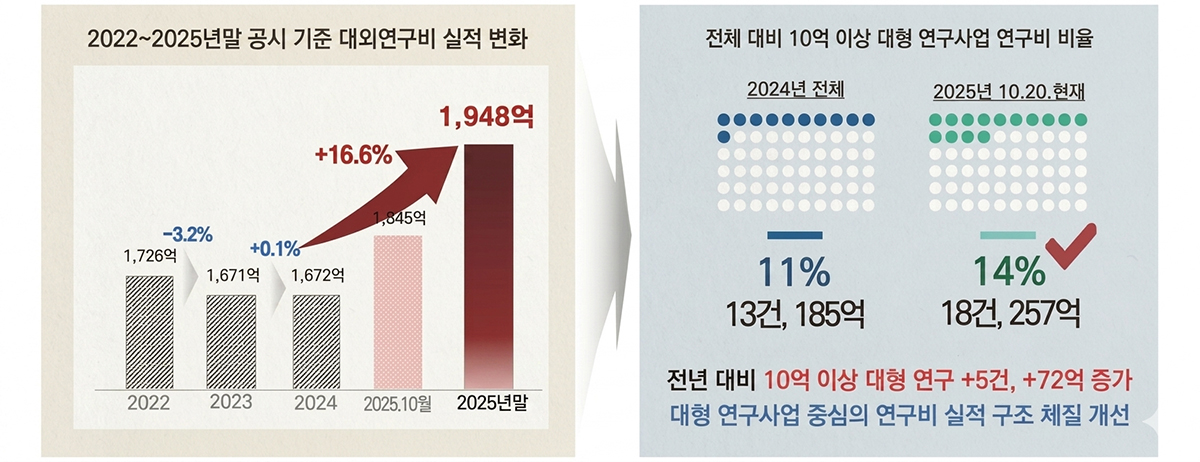
The most distinctive highlight of this year’s performance is the exponential growth in external R&D funding. In 2025, total external funding reached 194.8 billion KRW (across 1,383 projects)—a substantial leap of over 50 billion KRW compared to the 144.8 billion KRW recorded in 2020. This surge was driven by securing a series of major national projects, including G-LAMP, Glocal Lab, and HK3.0. Notably, the university saw a rise in advanced industrial technology research within science and engineering, alongside an accelerated convergence of basic science and clinical research in the medical sector. By establishing a robust institutional foundation to restructure its funding toward large-scale initiatives, Kyung Hee translated its strengthened research competitiveness into a steady expansion of industry-academic revenue, which reached 36.39 billion KRW (a 4.2 billion KRW increase from the previous year), ranking the university 9th nationwide.In the field of technology transfer, licensing fees reached 9.7 billion KRW based on 2025 performance indicators–a staggering 140% increase from the 4.05 billion KRW reported in 2024. This achievement reflects a qualitative leap in the value of Kyung Hee’s commercialized technologies. While the average fee per technology transfer contract hovered around 50 million KRW between 2021 and 2024, that figure surged to 127.7 million KRW in 2025. This surge demonstrates that Kyung Hee’s cutting edge technologies are effectively meeting industry demands, driving a sharp upward trajectory in all performance metrics.
One-Stop Services: Navigating the Shift Toward Large-Scale National R&D
National R&D projects have recently been restructured to prioritize large-scale, collective initiatives. To secure these major grants, universities must provide formal commitments of institutional support, including matching funds, dedicated research space, and reduced teaching loads for participating faculty. Previously, researchers bore the burden of coordinating these requirements across multiple administrative departments on their own. This administrative weight often led to researcher fatigue and hindered the university’s capacity to conduct systematic institutional reviews.To address these challenges, Industry-Academic Cooperation Foundation introduced the “One-Stop Service for Large-Scale Research Project Commitments.” The introduction of this service serves as a prime example of the paradigm shift toward “researcher-centered” administration. Under this new framework, a research researcher simply submits a project overview and a list of required support items through a single window. From there, the R&D Planning Team acts as a control tower, overseeing the entire process—from practical consultations with relevant campus departments and preliminary reviews to final institutional approval. The process, which was once manual and complex, has been streamlined using inter-departmental digital checklists. This has resulted in exceptional administrative efficiency; even urgent requests are processed within three to five days on average and are typically finalized one to two days ahead of project deadlines.
Administrative Excellence Driving Record Performance Metrics
Dismantling administrative barriers has directly translated into measurable growth in external research support. As of October 2025, the number of institutional support commitments processed through the One-Stop Service reached 756 cases—a 136% increase from the 324 cases in 2024. The number of specific grant applications supported also rose by 102% reaching 97 projects. These administrative improvements led to tangible success in securing high-value grants. Supported by an integrated system focused on large-scale initiatives, the number of projects valued at over 1 billion KRW increased by 38.5%, from 13 cases in 2024 to 18 in 2025. The total funding from these large-scale projects grew by 38.9%, reaching 25.7 billion KRW. Driven by this structural shift toward major R&D, the university’s total external research funding—which had previously plateaued around 167 million KRW—surged to approximately 194.8 billion KRW by the end of 2025.The One-Stop Service serves as the launching pad for future growth. Leveraging its current qualitative strengths—including a No. 1 ranking in patent registration and top-tier technology transfer fees—Kyung Hee has deployed a preemptive response system for 2026 government R&D projects. To secure massive national initiatives, such as National Research Labs and Leading Research Centers, the Industry-Academic Cooperation Foundation is spearheading pre-planning task forces (TFs). These initiatives include comprehensive package support for research planning groups, specialized funding for large-scale project development, and innovative financial incentive programs.
Institutional growth stems from the synergy between faculty excellence and the systems built to empower them. The Industry-Academic Cooperation Foundation remains committed to removing bureaucratic hurdles and acting as a stepping stone for researchers at the forefront of their fields. The One-Stop Service is a clear testament to the university’s dedication to championing its research community.