header
News
Professor Ki Joo Pahk Selected for the “Hanwoomul-Phagi” Basic Research Program
DATE 2026-05-26 13:56:46.0
- WRITER 학무부총장실
The Biomedical Ultrasound Engineering Lab, led by Professor Ki Joo Pahk of the Department of Biomedical Engineering, has been selected for the prestigious “Hanwoomul-Phagi” Basic Research Program, funded by the Ministry of Science and ICT and the National Research Foundation of Korea. This long-term initiative provides outstanding early-career researchers with approximately 200 million KRW in annual funding for up to 10 years to conduct deep, uninterrupted research in a single field. Professor Pahk’s team secured the grant for their pioneering project, "Development of Core Proprietary Technologies and Platforms for AI Robot Arm-Based Pressure Modulated Shockwave Histotripsy for Patient- and Disease-Customized Precision Treatment.”
Professor Pahk emphasized that seed funding from Kyung Hee University also played a critical role leading up to the full-scale launch of this research project. His research team conducted essential preliminary studies backed by a 60 million KRW grant over two years through the university’s “Future Leading Early-Career Researcher Support Program.” This internal funding allowed the team to design their research with greater flexibility compared to government-funded projects. Leveraging this tactical support, the team successfully conducted the foundational preliminary studies that ultimately secured their selection for the “Hanwoomul-Phagi” Basic Research Program.
Histotripsy is garnering traction as a next-generation, non-invasive ultrasound surgical modality. Following U.S. FDA approval for certain histotripsy devices in 2023, clinical applications are already underway for liver cancer patients. However, conventional histotripsy presents a distinct trade-off. While it excels at debulking large lesions, the acoustic scattering effect of shockwaves can inadvertently impact surrounding healthy tissue near the focal zone. This limitation makes it challenging to safely treat areas directly adjacent to major blood vessels, bile ducts, or critical nerves.
Professor Pahk focused his efforts on overcoming these precise boundaries. He explained, “Conventional histotripsy is a highly innovative technology, but we recognized a critical limitation: its insufficient precision can cause collateral damage to surrounding healthy tissues.” To overcome this barrier, the research team devised a novel, proprietary core technology that first nucleates a vapor bubble at the ultrasound focal point and then sequentially modulates acoustic pressure to control the bubble dynamics with much greater accuracy.
This technology is projected to be particularly transformative for high-stakes, sophisticated clinical scenarios, such as treating tumors directly adjacent to major blood vessels, vital organs, or critical nerve pathways. Professor Pahk explained, “Clinicians will be able to deploy this method with significantly higher safety margins, even when they need to ablate only a specific part of a lesion. Furthermore, by dynamically adjusting the timing of pressure modulation, they can precisely define the exact boundaries of the treatment zone.”
Going a step further, the research team is integrating AI and robot arm technologies into this platform. The AI engine will learn data regarding pressure modulation timing and lesion sizes to predict the treatment parameters desired by the practitioner. It will also analyze the patient’s anatomical information alongside acoustic simulation results to locate the ultrasound focal point with higher accuracy. Meanwhile, the robot arm will precisely deliver the ultrasound energy from optimal angles, drastically boosting treatment accuracy and procedural efficiency. Professor Pahk stated, “Our ultimate goal in this study is to implement a fully non-invasive precision treatment platform tailored to individual patients and specific disease characteristics by combining our core ultrasound technology with AI predictive models and robot arm-based precision control.”
Ultimately, the research team aims to implement a universal medical device platform capable of patient-customized, non-invasive precision treatment, which will eventually pave the way for technology transfer and commercialization. Professor Pahk anticipated, “Once we fully mature this technology, physicians will be able to precisely target and eradicate lesions without making a single incision. This will drastically minimize patient trauma and the complications often associated with conventional surgical procedures, while simultaneously maximizing treatment safety and efficiency.”
The clinical utility of this technology extends beyond oncology. Looking ahead, the research team sees strong potential for expansion into the field of cosmetic and regenerative medicine. Furthermore, they expect this system to serve as a foundational technology for biological tissue decellularization research, which is essential for cell transplantation therapies.
University Funding Lays the Groundwork for Research
This selection serves as an opportunity to further advance Professor Pahk’s ongoing research in therapeutic ultrasound, focused ultrasound, histotripsy—a non-invasive ultrasound technology used for tumor ablation. It also propels his work in cavitation, a phenomenon where microbubbles induced by ultrasound expand and violently collapse, generating physical force.Professor Pahk explained, “This project establishes a firm foundation for us to advance our world-first pressure-modulated shockwave histotripsy technology beyond the proof-of-concept stage and elevate it to a level ready for actual clinical application.” Concurrently, the laboratory views this long-term grant as an opportunity to steadily cultivate top-tier master’s and doctoral researchers in the field of biomedical ultrasound.Professor Pahk emphasized that seed funding from Kyung Hee University also played a critical role leading up to the full-scale launch of this research project. His research team conducted essential preliminary studies backed by a 60 million KRW grant over two years through the university’s “Future Leading Early-Career Researcher Support Program.” This internal funding allowed the team to design their research with greater flexibility compared to government-funded projects. Leveraging this tactical support, the team successfully conducted the foundational preliminary studies that ultimately secured their selection for the “Hanwoomul-Phagi” Basic Research Program.
The Need for Precise and Safe Non-Invasive Treatment
Professor Pahk’s research team is dedicated to developing a therapeutic technology capable of precisely removing tumors and lesions without the need for surgical incisions. Focused ultrasound delivers intense acoustic energy to a targeted area, non-invasively inducing either thermal or mechanical effects on the tissue. While conventional High-Intensity Focused Ultrasound (HIFU) thermalizes and burns target tissue using extreme heat, histotripsy physically ablates tissue into cellular debris using the mechanical force of microbubbles generated by acoustic cavitation.Histotripsy is garnering traction as a next-generation, non-invasive ultrasound surgical modality. Following U.S. FDA approval for certain histotripsy devices in 2023, clinical applications are already underway for liver cancer patients. However, conventional histotripsy presents a distinct trade-off. While it excels at debulking large lesions, the acoustic scattering effect of shockwaves can inadvertently impact surrounding healthy tissue near the focal zone. This limitation makes it challenging to safely treat areas directly adjacent to major blood vessels, bile ducts, or critical nerves.
Professor Pahk focused his efforts on overcoming these precise boundaries. He explained, “Conventional histotripsy is a highly innovative technology, but we recognized a critical limitation: its insufficient precision can cause collateral damage to surrounding healthy tissues.” To overcome this barrier, the research team devised a novel, proprietary core technology that first nucleates a vapor bubble at the ultrasound focal point and then sequentially modulates acoustic pressure to control the bubble dynamics with much greater accuracy.
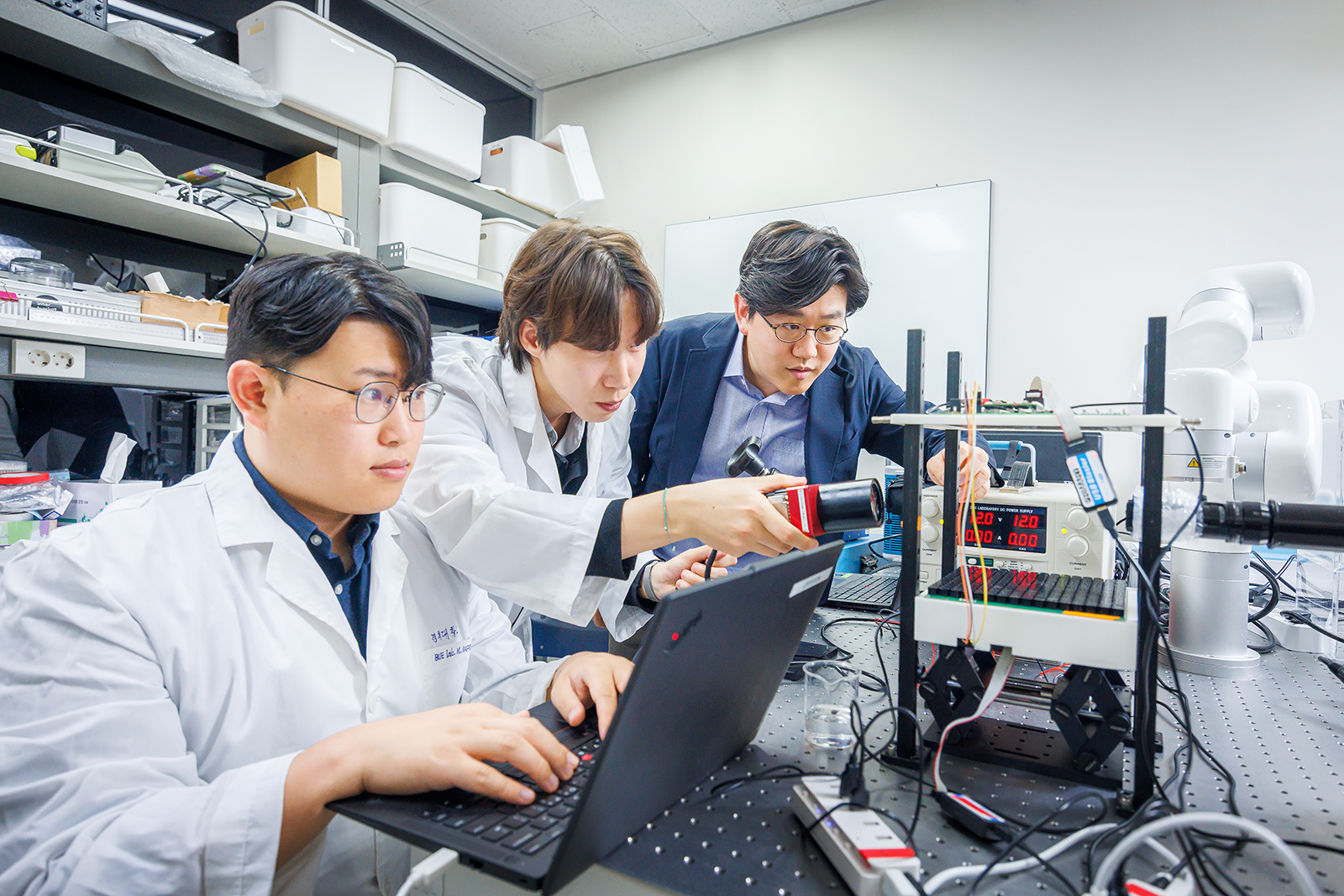
Professor Pahk’s team conducting advanced research on next-generation non-invasive therapeutic ultrasound technologies.
Achieving Precision Treatment Through Pressure-Modulated Shockwave Histotripsy
Professor Pahk’s research team has been developing “Pressure-Modulated Shockwave Histotripsy (PSH),” a technique that precisely regulates acoustic pressure fields. This innovative technology allows clinicians to finely tune the treatment zone according to the exact size and location of a lesion, thereby minimizing collateral damage to surrounding healthy tissue.This technology is projected to be particularly transformative for high-stakes, sophisticated clinical scenarios, such as treating tumors directly adjacent to major blood vessels, vital organs, or critical nerve pathways. Professor Pahk explained, “Clinicians will be able to deploy this method with significantly higher safety margins, even when they need to ablate only a specific part of a lesion. Furthermore, by dynamically adjusting the timing of pressure modulation, they can precisely define the exact boundaries of the treatment zone.”
Going a step further, the research team is integrating AI and robot arm technologies into this platform. The AI engine will learn data regarding pressure modulation timing and lesion sizes to predict the treatment parameters desired by the practitioner. It will also analyze the patient’s anatomical information alongside acoustic simulation results to locate the ultrasound focal point with higher accuracy. Meanwhile, the robot arm will precisely deliver the ultrasound energy from optimal angles, drastically boosting treatment accuracy and procedural efficiency. Professor Pahk stated, “Our ultimate goal in this study is to implement a fully non-invasive precision treatment platform tailored to individual patients and specific disease characteristics by combining our core ultrasound technology with AI predictive models and robot arm-based precision control.”
A 10-Year Vision for Expanding Precision Treatment
This research initiative will unfold in phases over the next decade. During the first five years, the team will focus on perfecting the core proprietary PSH technology, alongside developing AI-driven predictive and monitoring models and high-precision robot arm control systems. In the subsequent five years, the team will integrate these components into a unified, cohesive platform and thoroughly verify its clinical viability through animal testing and performance validation.Ultimately, the research team aims to implement a universal medical device platform capable of patient-customized, non-invasive precision treatment, which will eventually pave the way for technology transfer and commercialization. Professor Pahk anticipated, “Once we fully mature this technology, physicians will be able to precisely target and eradicate lesions without making a single incision. This will drastically minimize patient trauma and the complications often associated with conventional surgical procedures, while simultaneously maximizing treatment safety and efficiency.”
The clinical utility of this technology extends beyond oncology. Looking ahead, the research team sees strong potential for expansion into the field of cosmetic and regenerative medicine. Furthermore, they expect this system to serve as a foundational technology for biological tissue decellularization research, which is essential for cell transplantation therapies.