header
News
Young Researchers Thrive in an Autonomous Research Environment
DATE 2026-04-13 11:00:46.0
- WRITER 학무부총장실
“An opportunity to reflect on research directions and commit to new responsibilities.” Yu-seop Kim (PhD Candidate, Mechanical Engineering)
For Yu-seop Kim, being selected for this scholarship serves as a powerful validation that his past efforts were not in vain. After completing his Master’s degree, he transitioned into the doctoral program, where he plans to significantly deepen and evolve his current research.
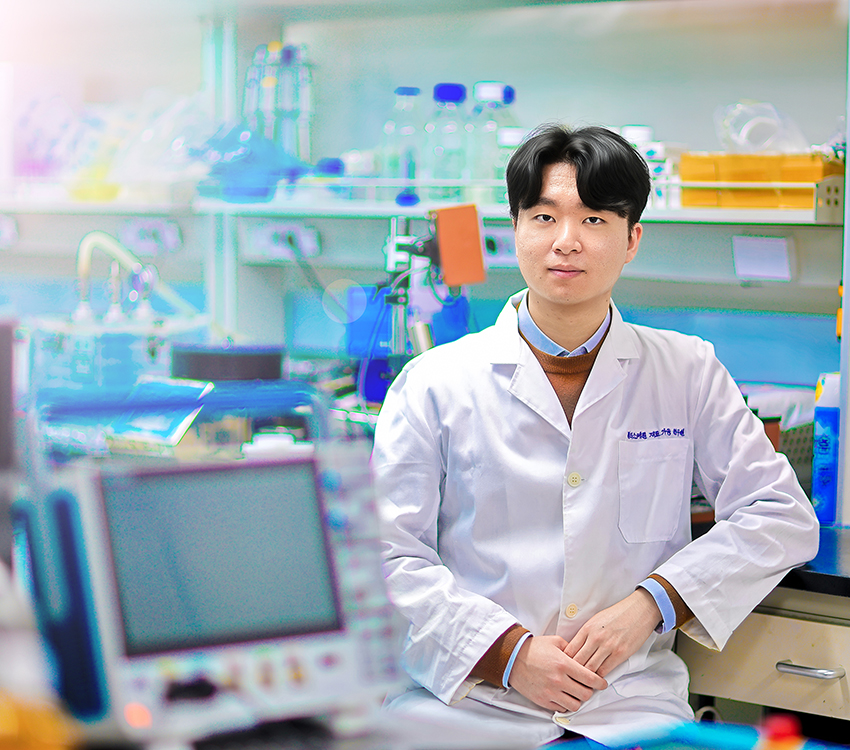
Building on a foundation of fundamental mechanical engineering theory and design expertise, Kim developed a keen interest in energy harvesting—the technology of converting ambient energy, such as movement or vibration, into electricity. While personally fabricating and verifying power-generation devices during his Master’s studies, he discovered the potential to expand this technology into “self-powered sensors” that operate without the need for external power sources. Recently, his work has focused on developing sensors that can harvest energy from even the slightest movements to operate independently.
Furthermore, Kim is developing a multimodal sensor that mimics the cupula structure found in the lateral lines of fish and the human vestibular system. This sensor can simultaneously detect pressure, shear force, and contact location. By utilizing a flexible dome-shaped structure and an air-gap design, the sensor generates distinct signal patterns based on the direction and location of a stimulus. This technology holds great promise for applications in electronic skin and robotic tactile systems. To ensure the precision of these sensors, Kim is also developing a manufacturing process for the precise machining of polymer materials in the “Meso-scale While Zone”—a middle-ground scale where fabrication standards have yet to be fully established. His ultimate goal is to secure manufacturing efficiency by achieving precise control within this challenging scale.
Kim also shared his personal resolve: “Being selected for this scholarship has motivated me to pursue my doctoral studies with an even greater sense of responsibilities.” His future goal is to build an energy-autonomous platform that integrates power generation devices with sensors. Furthermore, he aims to secure mass-production process technologies to advance his research findings all the way to the commercialization stage.
Finding Answers in Biological Sensory Structures
Inspired by biological sensory organs, Yu-seop Kim is developing high-sensitivity triboelectric sensors that generate their own electricity without an external power source. Because triboelectric sensors generate signals through the charge produced when two materials contact and separate, they typically struggle to detect “static pressure”—force that is applied and held still. To overcome this, Kim introduced an “Origami Kresling” structure, which converts static pressure into internal rotational motion. This allows the sensor to output a continuous signal by generating minute internal movements even when a static force is applied. Having already produced a prototype, he is currently optimizing performance based on various structural and material variables.Furthermore, Kim is developing a multimodal sensor that mimics the cupula structure found in the lateral lines of fish and the human vestibular system. This sensor can simultaneously detect pressure, shear force, and contact location. By utilizing a flexible dome-shaped structure and an air-gap design, the sensor generates distinct signal patterns based on the direction and location of a stimulus. This technology holds great promise for applications in electronic skin and robotic tactile systems. To ensure the precision of these sensors, Kim is also developing a manufacturing process for the precise machining of polymer materials in the “Meso-scale While Zone”—a middle-ground scale where fabrication standards have yet to be fully established. His ultimate goal is to secure manufacturing efficiency by achieving precise control within this challenging scale.
Embracing New Challenges with Confidence
Yu-seop Kim officially entered the doctoral program this semester. “A year ago, I saw a senior in our laboratory receive the Presidential Science Scholarship, and that inspired me to follow in their footsteps,” he shared. He advised juniors interested in academia that many scholarship programs exist to support graduate students. Kim noted that since the journey toward a PhD is not short, actively utilizing such institutional support can provide the courage needed to pursue ambitious research.Kim also shared his personal resolve: “Being selected for this scholarship has motivated me to pursue my doctoral studies with an even greater sense of responsibilities.” His future goal is to build an energy-autonomous platform that integrates power generation devices with sensors. Furthermore, he aims to secure mass-production process technologies to advance his research findings all the way to the commercialization stage.
“Achieving the Presidential Science Scholarship through a culture of autonomous research.” Donghan Lee (PhD Candidate, Mechanical Engineering)
Citing the laboratory’s atmosphere of respecting autonomous research as his primary driver for growth, Donghan Lee added, “The time we spent sharing research ideas became a vital catalyst for broadening my intellectual horizons.”
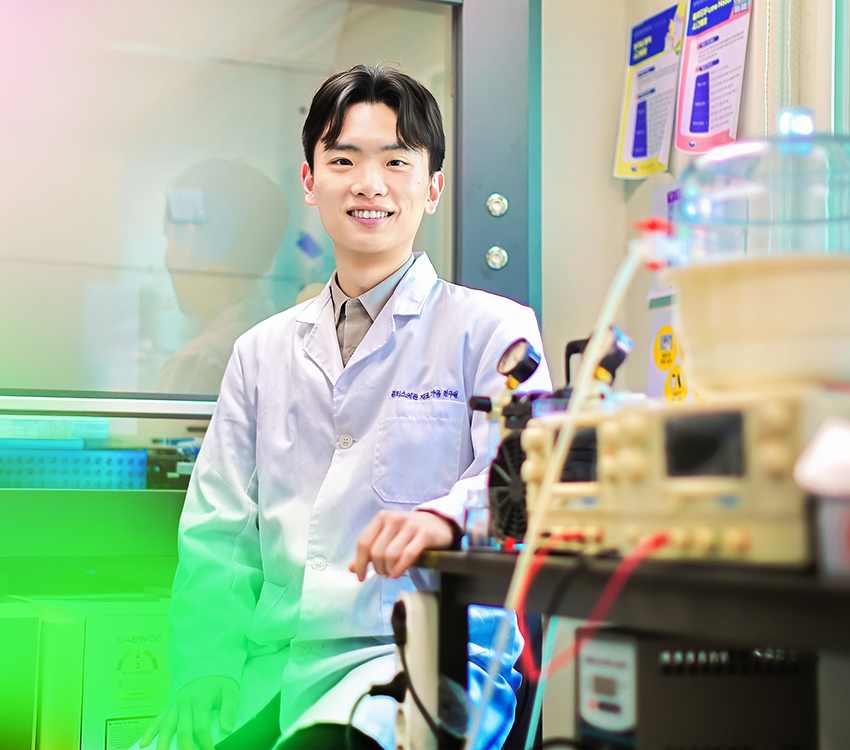
Driven by a fascination with the interaction between the motion of objects and force, Donghan Lee chose to major in mechanical engineering. While studying traditional mechanics, he noted that static charges could influence both physical and biological systems even without an external power source. He discovered that electrostatic technology could generate substantial value when converged with other fields, moving beyond conventional mechanical design. His research subsequently expanded into the development of electret technology—encompassing the generation, storage, and application of static charges—and its convergence with the biological sciences.
Lee’s research also extends into the biological sciences. Previously, applying a continuous electrostatic field to cells was limited by the need for bulky, kilovolt-level high-voltage equipment. By utilizing electrets, Lee is conducting convergence research on cell culture, scar suppression, and the regulation of cell proliferation and differentiation. To date, he has participated in six collaborative studies to identify the effects of electrostatic fields at the cellular level. Additionally, Lee is conducting research on static charge generation using Triboelectric Nanogenerators (TENGs). By analyzing the characteristics of input energy, he seeks designs that can efficiently harvest energy even in irregular environments, reaching significant milestones after extensive trial and error.
Building on these experiences, Lee aspires to grow into a convergence researcher who bridges the gap between electrostatic application technology and tangible social value. Recognizing the immense potential of electret technology, he plans to expand his focus toward the practical application stage. He intends to enhance technical maturity by developing materials with high charge stability and biocompatibility, while expanding collaborative research across diverse sectors, including electrical and electronic engineering, biotechnology, and environmental engineering. Furthermore, he is exploring ways to make a direct impact on society through technology transfers or entrepreneurship.
Expanding into the Generation, Storage, and Convergence of Static Charge
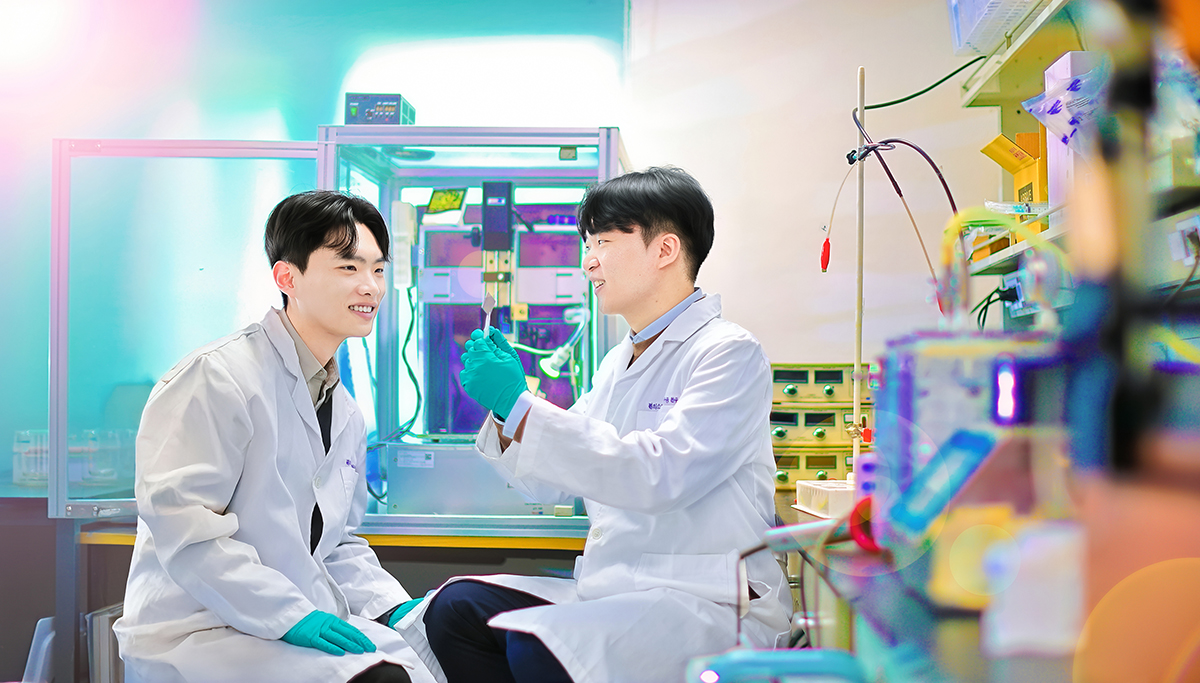
Lee’s research is structured around two major pillars: the storage and application of static charge and the generation and utilization of static charge. Currently, he is focused on developing electrets capable of maintaining a semi-permanent electrostatic field without an external power source. While electrets have vast applications in microphones, dust filters, and energy harvesting devices, research has often remained in its early stages due to limitations in charge stability. To address this, Lee has established a high-quality electret manufacturing process that integrates charge injection, material processing, and packaging technologies to ensure the stable retention of large charge volumes. Furthermore, he utilizes a 3D potential measurement system and a Thermally Stimulated Discharge Current (TSDC) system to quantitatively analyze the electrical characteristics of these electrets, allowing for a precise evaluation of charge distribution and stability within the materials.Lee’s research also extends into the biological sciences. Previously, applying a continuous electrostatic field to cells was limited by the need for bulky, kilovolt-level high-voltage equipment. By utilizing electrets, Lee is conducting convergence research on cell culture, scar suppression, and the regulation of cell proliferation and differentiation. To date, he has participated in six collaborative studies to identify the effects of electrostatic fields at the cellular level. Additionally, Lee is conducting research on static charge generation using Triboelectric Nanogenerators (TENGs). By analyzing the characteristics of input energy, he seeks designs that can efficiently harvest energy even in irregular environments, reaching significant milestones after extensive trial and error.
Toward the Social Application of Electrostatic Technology
“This scholarship allowed me to validate the value of the research I have dedicated five years to, and it feels as though my past efforts have been truly recognized,” said Donghan Lee, sharing his reflections on being selected for the award. Set to graduate from his doctoral program this summer, Lee has sustained his research through various institutional support systems. The combination of publication-based scholarships, teaching assistantships, and laboratory stipends—now supplemented by the Presidential Science Scholarship—has allowed him to immerse himself fully in his academic pursuits.Building on these experiences, Lee aspires to grow into a convergence researcher who bridges the gap between electrostatic application technology and tangible social value. Recognizing the immense potential of electret technology, he plans to expand his focus toward the practical application stage. He intends to enhance technical maturity by developing materials with high charge stability and biocompatibility, while expanding collaborative research across diverse sectors, including electrical and electronic engineering, biotechnology, and environmental engineering. Furthermore, he is exploring ways to make a direct impact on society through technology transfers or entrepreneurship.
An autonomous research environment empowers students to take initiative in their investigations and cultivate creative ideas, serving as the bedrock for meaningful research outcomes. This culture of excellence is clearly reflected in the laboratory’s recent achievements. Professor Dongwhi Choi’s lab has now produced a total of three Presidential Science Scholars over the past two years.