header
News
“A Journey of Great Transformation: Kyung Hee’s Aspirations Never Cease”
DATE 2026-02-23 11:12:59.0
- WRITER 학무부총장실
Kyung Hee University System celebrates 2026 with the New Year’s Ceremony and Greeting
Reflecting on the history of the Kyung Hee spirit born from the ruins of war and re-examining the institution’s management philosophy
Chairman Inwon Choue: “The Kyung Hee tradition is a holistic horizon of excellence that bridges history, the present, and the hope of our future.”
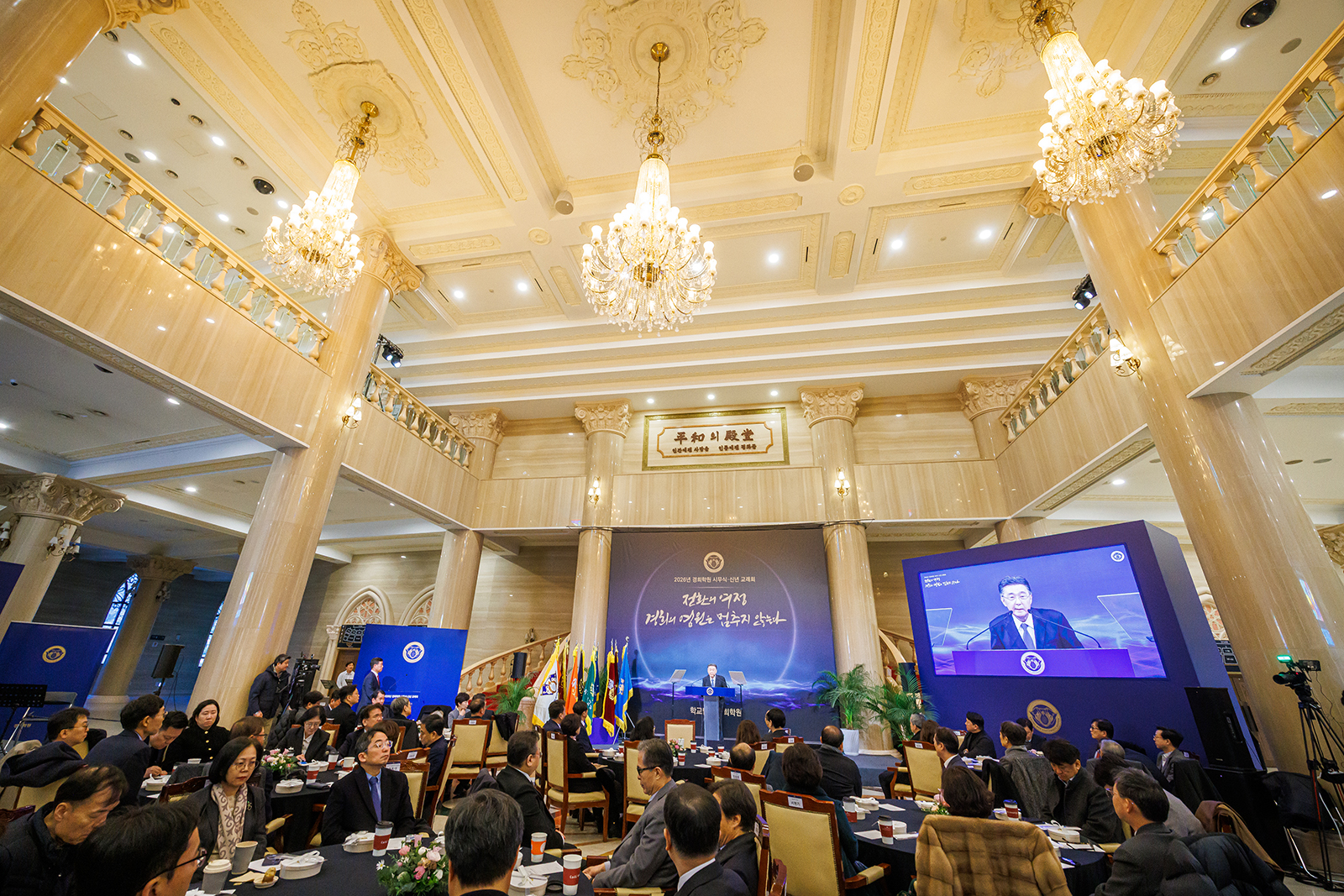
The 2026 Kyung Hee University System New Year’s Ceremony and Greeting was held on Monday, January 5, in the lobby of the Grand Peace Hall. Each year, the Kyung Hee University System—including the corporation, university, cyber university, medical centers, and affiliated schools—comes together to reflect on the past year and strengthen their resolve for the year ahead. Heads of various institutions and key administrative members attended the event in person, while faculty and staff participated in real-time via webcast.
The event revisited the moment the founding spirit of the Kyung Hee University System was born, reflecting on today’s reality amidst a turning point in civilizational history. It served as a platform to share the responsibilities and aspirations for the new year through a perspective that looks back at the present from the future.
The History of Kyung Hee’s Beginnings: Trials and Resolve
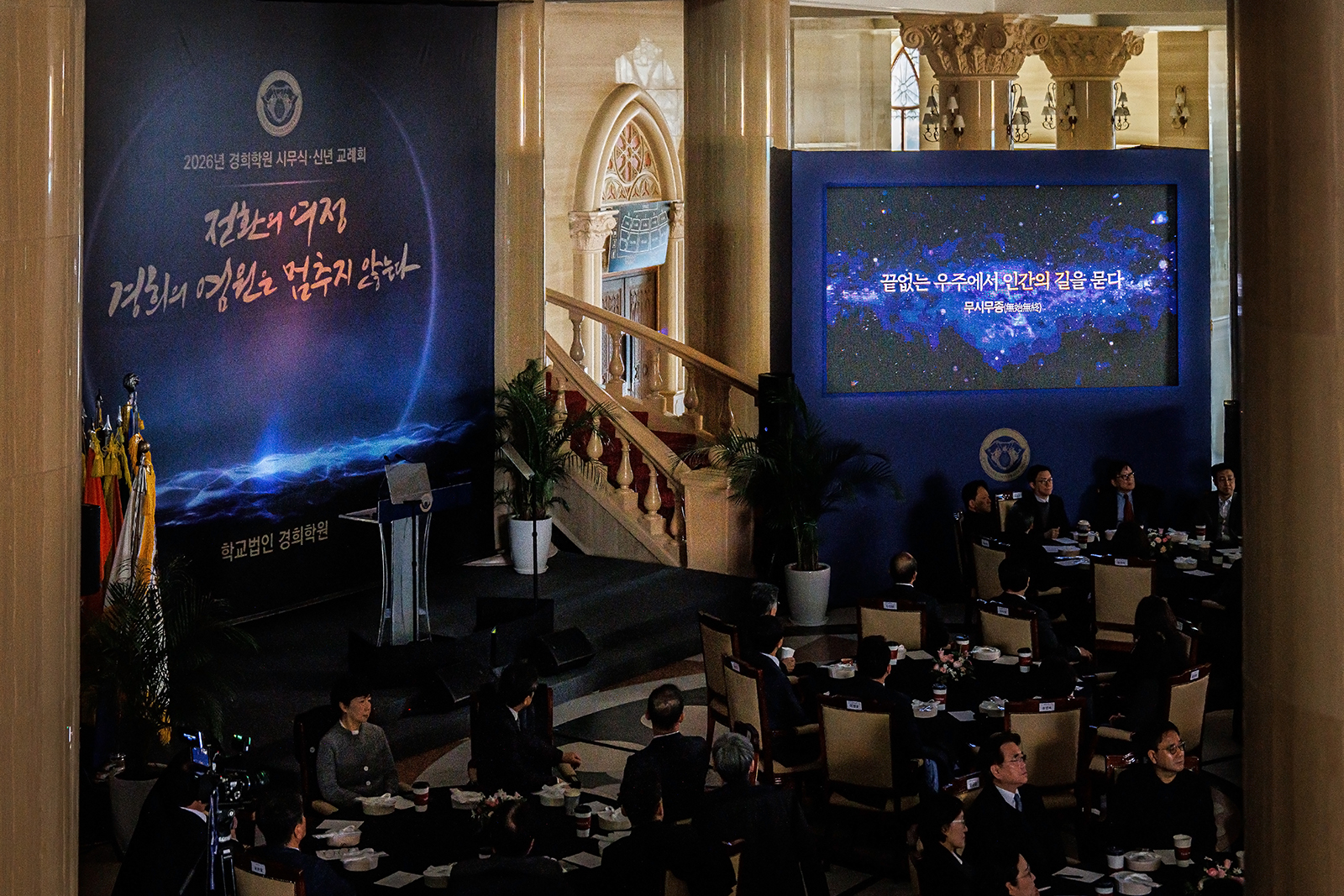
The ceremony featured the screening of a newly produced video titled A Narrative of Hope: The Path of Kyung Hee Carved from the Ruins. Based on the first chapter, “The Birth of Kohwang,” from the 1969 book 20 Years of Kyung Hee, the video reconstructs the journey of the university’s early years. It begins with the acquisition of the foundation in May 1951 during a period of severe financial hardship and traces the subsequent opening of classes in Busan during the Korean War. It also details the construction of the Donggwang-dong school building using 18 million won of personal funds, its tragic loss to fire, the era of the rebuilt Dongdasin-dong campus, and the acquisition of new grounds in 1954 to secure the future of “Kohwang” after the armistice. Drawing on the history of its founding, the video captures the creative resolve of Kyung Hee to rise from the ruins and its spiritual legacy of persevering through adversity.In the subsequent New Year’s address, Chairman Inwon Choue of the Kyung Hee University System explored the theme, “A Journey of Great Transformation: Kyung Hee’s Aspirations Never Cease.” Overlapping the narrative of the video with today’s reality, he revisited the philosophical roots of the university’s founding spirit and shared his thoughts on Kyung Hee’s role in the “Era of Great Transformation” we face today. Chairman Choue began by focusing on two specific expressions from the video: yusiyujong (a Korean idiom meaning “having a beginning and an end”) and musimujong (meaning “having no beginning and no end”).
Chairman Choue explained, “Yusiyujong represents Kyung Hee’s belief—forged in the desperate circumstances of losing everything to war and fire—that ‘every hardship that begins must also have an end.’ It is the language of existential hope that allowed us to rise again from adversity.” Simultaneously, he noted, “Musimujong is the realization that although human life is finite, the world of truth and the universal principles we must pursue flow infinitely, without beginning or end.” He continued, “Nature and the universe are, in fact, indifferent to humanity; they do not selectively alleviate our pain or trials. Yet, that very indifference grants us the ‘reflective freedom’ to design our own paths within an infinite truth.” He added, “Kyung Hee’s founding spirit, the ‘Creation of a Civilized World,’ is not about mimicking established ‘answers.’ It is a journey of reflection and creation—a deeper inquiry into human dignity and truth as we move toward an infinite horizon within our physically finite lives.”
Kyung Hee’s journey—spanning from the fires of Donggwang-dong in Busan to Dongdaesin-dong and eventually Mount Kohwang in Seoul—is a history forged by the interplay of survival and existence. It was built by overcoming suffering through the lens of yusiyujong while seeking the eternal through musimujong. It stands as a living testament to the Kyung Hee spirit: “dreaming of the future amidst the ruins and calling the hope of that future into reality.”
▶ Watch A Narrative of Hope: The Path of Kyung Hee Carved from the Ruins
Survival and Existence: In Search of a Holistic Horizon of Excellence
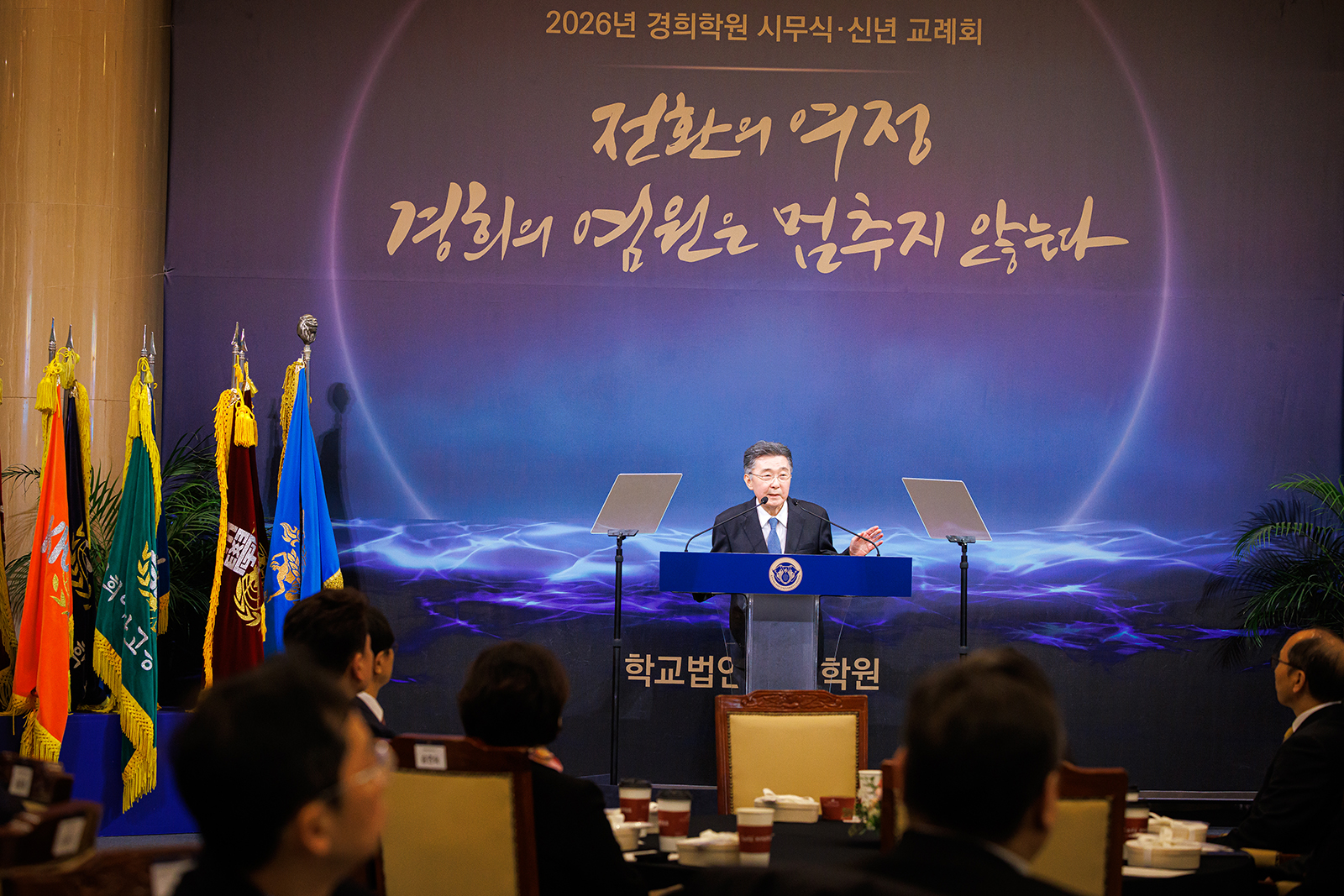
Chairman Choue then addressed the fundamental questions of “survival and existence.” He noted, “Whether for an institution or an individual, life is always accompanied by these two themes: survival and existence. From the perspective of today’s institutional management, survival is a matter of how to manage finances, human resources, external relations, status, and facilities under competitive conditions to maintain institutional stability and growth. Existence is a matter of fundamental values, such as ‘What is a university?’ and “Why and for what purpose does it exist?’” According to Chairman Choue, “Survival reminds us of a fierce and harsh reality. Existence, however, is different. Existence is a process of keeping open the possibility of challenging the world that is possible and the world that seems impossible, and empirically transforming the truths or ultimate tasks therein. It is an attitude of mind to accept reality as it is, while sublimating the fundamental principles of the beyond—humanity and the world, nature and the universe—into aesthetic public practice.”As shown in the narrative of Kyung Hee’s founding—from the desolate wartime refuge of Busan to the barren wilderness of Mount Kohwang—Kyung Hee did not separate its future task of the “Creation of a Civilized World” (its goal of “existence”) from the fierce reality of survival. Even amidst hardships, an existential consciousness oriented toward a “seemingly impossible future” was integrated into the practical pursuit of survival: building the university, securing finances, and forming a community of faculty, staff, and students. Building upon the forward-looking orientations established during the war—the “Democratization of the Academy,” “Democratization of Thought,” and “Democratization of Daily Life”—the “realistic ambition” of the nascent university was expressed as follows:
“ I have no desire to simply model this institution after any particular university in Korea. My heart is set on creating a university that is truly unique—one that is more profoundly rooted in the Eastern spirit than any other in this nation, yet capable of competing with the most eminent universities in the world. I believe this cannot be achieved without dedicating a hundred, even a thousand times more effort and sincerity.”
-From Dr. Young Seek Choue’s inaugural address as President, May 20, 1954
From a comprehensive standpoint, Chairman Choue interpreted Kyung Hee’s early history as a “declaration of the will to achieve global excellence upon our own unique spiritual foundation, rejecting the competition of mimicking specific universities during a time when Korea was one of the world’s poorest nations.” This vision sought to build a world-class, unique university through the “reflective creation” of two major currents: a deep contemplation of the spiritual world of ancient Eastern philosophy and a scientific understanding of the nature of matter and its material foundations rooted in Western discourse. In short, Kyung Hee’s vision was a new path—the so-called “Third Way”—that transcends the limitations of “boundaries and reductionism” as well as “inertia and conventional wisdom.”
The contemplation of survival and existence contains the essence of the Kyung Hee philosophy: the holistic sublimation of the generation of juri (governing principles) and jui (governing will). Kyung Hee views civilizational development as a process in which the generation of juri and jui are intertwined to create harmony. When human consciousness and the will to practice—which seek to perceive the principles of the universe where everything is interconnected and respond to them correctly—are combined, the world can move in a more complete direction. While juri-saengseong (emergence of juri) is the process of an infinite unfolding of order and harmony already permeated within nature, history, and the universe, jui-saengseong (emergence of jui) is the deepening of human consciousness and decision-making—asking “What shall I do” and “How shall I live?”—within that flow. The two are inseparable.
“Nature, the very essence of cosmic order, is in itself a realm of vast silence and indifference.
Paradoxically, that infinite void grants usthe creative freedom to design the ‘human path’ for ourselves.
The ‘Creation of a Civilized World’ is not a path of following established answers;
it is an endless journey of reflection–grasping universal truths and maturing the dignity of humankind.”
Chairman Choue explained juri as “the world of principles that flow through the universe, nature, and human society,” and jui as “the world of historical consciousness and the will to practice, where individuals and communities choose their paths based on those principles.” He emphasized that “the core of the Kyung Hee narrative is to examine the world of ri (principle) and the word of ui (will) through an organic, multi-dimensional, and holistic integration.” As insight into these principles deepens, consciousness looks further ahead; as consciousness is elevated, these principles are manifested in a more complete state. The generation of juri and jui is a process of mutual creation and transitional movement. Within this philosophy, Kyung Hee sought a path of existence and a path toward a new civilization—opened jointly by universal principles and human consciousness—moving beyond simple acquisition and survival. This will to practice and spirit constitute the “Leadership of Consciousness” and the act of powol (encompassing transcendence), which involves fiercely embracing the limitations and contradictions of oneself and the world to seek the possibilities of a better world.
Kyung Hee’s tradition of academics and peace is based on the creative fusion of “culture” and “science.” Chairman Choue noted, “From its inception, Kyung Hee was designed so that the humanistic value of peace and the rational reason of science would constantly interlace and create a synergistic effect.” He viewed this as an “eternal journey of dialectics and integration, aiming to pioneer a new future for humanity by harmonizing the values and philosophies of Eastern and Western civilization.” The “Creative Civilized World” pursued by Kyung Hee refers to a civilizational paradigm where the dazzling advancement of science, technology, and knowledge systems (“Hall of Academe”) finds its way and flourishes within human spiritual elevation and peaceful values (“Hall of Peace”). This is a holistic sublimation that leads to another dimension where body and soul, matter and spirit, reason and emotion, and scientific rationality and spiritual values do not conflict but rather converge and embrace one another. Chairman Choue reaffirmed that this process is both the future and the aspiration that Kyung Hee must undertake and challenge.
The Lion and the Magnolia: The Path of Holistic Existence
The “Lion,” Kyung Hee’s symbol, and the “Magnolia,” the university flower, also embody this holistic orientation. The lion statue, erected in September 1959 following the completion of the University Administration Building, differs from conventional depictions; it bears a smiling face, concealing its dignity within. The lion symbolizes wild, robust survival and the will to overcome reality, harboring the spirit of survival to navigate a harsh world. However, the Kyung Hee Lion does not stop there. It sublimates its formidable strength into a smile. Instead of flaunting or asserting power, it moves through the world with tolerance and inclusion. It seeks the will of tolerance that humans can harbor within the principles of nature and universal order—transcending mere human sentiment—and pursues deeper truths within the human world.The Magnolia forms another axis alongside the smiling lion. Known as the “harbinger of spring,” the magnolia possesses the vitality of a pioneer, being the first to bloom through the harsh cold. As a “model of life that blooms and withers together,” the magnolia is an entity inherent with the shared beauty of humanity and life. The strength with which the magnolia endures winter is not blind patience, it stems from an aesthetic aspiration to open the way for a better spring. Chairman Choue noted, “The magnolia symbolizes a ‘harmonious and beautiful life’ that resembles patience, pioneering, and the ultimate coherence of the universe.” He added that if we consider the aesthetic nature of our ideals and practical efforts, it can be interpreted as an orientation toward a life where freedom exists, yet all things can harmonize with one another. The Lion and the Magnolia together personify the path of holistic existence—where the holistic harmony of juri-saengseong and jui-saengseong, strength and tolerance, survival and existence, order and freedom, and ultimately, reflective freedom and creation, all breathe as one.
Chairman Choue also called for the spirit of the Magnolia and the Lion to be reflected in the operation of the institution. This was in the context of emphasizing the professional duties of administrators regarding the “Precautionary Principle” of institutional management. “The precautionary principle means preemptively establishing a framework for institutional administration and management that forecasts crises and manages them during normal times,” he stated. “Institutional managers must always keep a close eye on signs of crisis and maintain a mindset of thorough management. The true duty of an administrator is not to scramble for solutions after a crisis has erupted but to detect and manage signs of trouble during periods of stability.” He continued, "Administrators must detect and thoroughly prepare for potential issues before members of the community even begin to sense anxiety or crisis. Just as the magnolia prepares for spring by enduring the cold winter, an institution’s crisis management must involve a routine of multifaceted preparation, both in the short and long term. Furthermore, this entire process of preparation must always be accompanied by aesthetic reflection and a deep sense of responsibility toward realizing the common good and making a civilizational contribution.”
This is not merely about institutional performance metrics and management indicators highlighted by the practical world. It is intertwined with the responsibility to meticulously cultivate the path of true academics and learning that lies beyond—the path of global practice and the harmonious integration of our members’ daily lives with institutional decision-making. Chairman Choue emphasized that we must sublimate survival and existence through the pursuit of inspiration-evoking beauty, opening a path for institutional development that encompasses both the spiritual and civilizational worlds. He noted, “While this work is for ourselves, it is also profoundly important for current and past members of the Kyung Hee community who have shaped our history and our future members. For those involved in institutional administration, yesterday, tomorrow, and the distant future are every bit as significant as today.” As these words suggest, the defining theme for Kyung Hee in 2026—the Year of the Fire Horse—is to synthesize history and the present through a future-oriented consciousness, to weight human awareness against universal principles, and to pursue the extraordinary vision and resolve required to create opportunity from crisis, all while seeking the holistic horizon of excellence in institutional management.
A New Phase of Transition: “Deep Crisis” and “Deep Response”
Today’s era is a “strange and unfamiliar phase that humanity is experiencing for the first time.” It is a time of civilizational transition where our modes of existence and survival are being fundamentally altered by the climate crisis, nuclear threats, Unidentified Anomalous Phenomena (UAP), and the trajectory of artificial intelligence and quantum computing toward superintelligence. Chairman Choue advised expanding this perspective from the individual level to a planetary scale. He noted that “the problems we face today are civilizational challenges that cannot be resolved through short-term policies or technological solutions alone.” As an educational institution, Kyung Hee is tasked with the responsibility to “disclose facts close to the truth, however uncomfortable they may be, and to contemplate solutions for the sustainable future of generations to come.”Chairman Choue identified the climate crisis as the foremost challenge. He referenced UN Secretary-General António Guterres’s 2022 COP27 warning that “we are on a highway to hell with our foot on the accelerator,” and pointed out that the climate crisis—once a focal point for the world—is disappearing from the forefront of media and politics. Chairman Choue questioned whether the crisis truly vanishes simply because someone in power asserts that “the climate crisis is not a crisis,” Emphasizing a shift in individual consciousness, he said, “Discussions on carbon reduction have vanished, and the media no longer shows significant interest. Yet, whether we desire it or not, the climate crisis will eventually transform human life in its entirety. Individual perspectives and actions are more crucial than ever. It is not necessarily desirable to fix our categories of thought according to conventional wisdom and public opinion. In this era of great transition, each of us bears the responsibility to look soberly at what is true.”
He also raised significant points regarding recent discussions on UAP. “The idea that humans are the only intelligent beings in the vast universe may be beyond common sense,” he remarked, urging a view of the possibilities of life and intelligent beings from a cosmic perspective, noting that “there is no reason for the evolution of countless planets and life forms to mirror our own.” He emphasized the gravity of the issue by citing the “UAP Disclosure Act” currently being pursued by U.S. Congress, four congressional hearings held in recent years, and a documentary featuring testimonies from 34 high-ranking officials—including former directors of the CIA and National Intelligence, the head of the Pentagon’s UAP Task Force, military generals, and intelligence officers. The documentary in question is The Age of Disclosure (Directed by Dan Farah, 2025), which provides testimony on UAP and Non-Human Intelligence (NHI). While there are critical views of the film, it holds great significance for its civilizational call to transcend the existing human-centric, modern worldview and for posing fundamental philosophical questions about humanity’s place in the universe and the direction of civilization.
“In this era of great transition, each of us bears the responsibility to look soberly at what is true.
Rather than simply remaining withinthe conventional wisdom led by society and the media,
we mustreinterpret human society within a cosmic context and cultivate a foundation of learning for future generations.
This is the solemn task of our educational institutions today.”
Chairman Choue proposes a responsible approach that reinterprets human society within a cosmic context. “As I mentioned earlier, there is no basis to assume that the evolutionary journey of the universe must be identical to that of humans,” he stated. “In a near-infinite number of planets, evolutionary paths different from those of humanity may have occurred. While this remains a question without a definitive answer, we must keep the possibility open and deeply contemplate what this means for mankind. From a civilizational standpoint, determining what kind of consciousness we will maintain and what questions we will pose for the future is one of the largest and gravest challenges we have ever faced in human history.”
He also emphasized the future challenges that will be created by AI and quantum computing. “We stand at a turning point surrounding the emergence of Artificial General Intelligence (AGI) and, eventually, Super Intelligence that transcends human intellectual capacity.” He noted that especially when combined with quantum computers capable of calculating complex subatomic interactions, “a situation may arise where we must rewrite not only our existing labor and socio-economic structures but the civilizational paradigm itself.” This, he argued, is why future forecasting is directly linked to the survival and existence of Kyung Hee.
Chairman Choue diagnoses the civilizational challenges facing humanity as a “deep crisis.” While leaving the horizon of interpretation open for individuals to decide how to view this crisis, he emphasized that we stand before another desperate task of survival and existence—an undeniable universal existential crisis.
“The current crisis is not simply a matter of scale. It signifies that human civilization and human existence itself are heading toward an unknown abyss where they could collapse. In this regard, the solution also requires a “deep response” that goes beyond physical or technological measures. It is not about managing or fixing the surface of the problem; the human consciousness and modes of existence that brought about the crisis must fundamentally change. The leadership of consciousness—the ability to rethink and gain insight into the direction of civilization and the inner path of humanity without being swept away by the turbulent waves of reality—is crucial. A holistic understanding of our global planetary society, the courage to simultaneously embrace the horizons of hope and destiny, and the act of powol (encompassing transcendence) appear more desperate than ever.”
A Perspective of the Future: “Kyung Hee’s Aspirations Never Cease”
The New Year’s address concluded with reflections on the “Perspective of the Future.” Chairman Choue posed a poignant question: “When we look back on today from the distant future we once dreamed of, will we be able to say we do not regret our current choices?” He continued, “The future is not merely ‘time that has yet to arrive,’ When viewed as a light that illuminates the present from that future vantage point, hope is not simple optimism; it is the source that transforms our current choices.” Within this awareness, he emphasized the aesthetic practice and sense of responsibility that Kyung Hee has always pursued—a fusion of reality and the future.“The past, present, and future are not disconnected. They possess a ‘holistic connectivity’ that communicates and influences one another as a unified whole. The future is not a fixed destiny simply drawing near; it is newly generated at every moment based on what our consciousness chooses and how we decide today. This is a vital framework of consciousness for those involved in institutional management and administration. The essence of institutional administration is to consistently cultivate a foundation where members can learn, research and live to their fullest, while dreaming of an even greater future. To this end, admissions and career placement, personnel and finance, and reputation management are unavoidable realities. However, while standing firmly on the ground of that reality, we must not be trapped by the fixed notion that ‘this is the only reality.’ Our daily duty in institutional administration is to reflect on the deeper reality that exists beyond the framework of established notions and demands by the world, and to constantly re-illuminate the reality of today.”
In this regard, the sphere of responsibility is not limited to the present day alone. Those in charge of institutional management are called to fulfill a responsibility toward history and tradition, a responsibility to manage the present more successfully than the past, and a responsibility to seek out a challenging and pioneering path toward the future. This requires a multidimensional responsibility: reflecting on the legacy of the past, managing the gravity of the present, and simultaneously summoning the possibilities of the future into the “here and now.” Chairman Choue stated, “Whether in the past or present, the themes of survival and existence remain vital. As long as we are grounded in reality, we must navigate it somehow. The reality facing each institution is different. While we must stand firmly on the ground of reality and manage it successfully, we must always keep in mind the paradoxical truth that this current state is not the only reality. We must always consider what lies beyond–the reality that will unfold tomorrow, and the reality that will unfold the day after.”
In his concluding remarks, Chairman Choue emphasized that the phrase “Kyung Hee’s Aspirations Never Cease” is a promise to recreate the reality of today by looking back at ourselves from the vantage point of the future.
“Trials have a beginning and an end (yusiyujeong). Nevertheless, the world of principles and the path of truth remain infinitely open (musimujeong). Within that lies the human path. Human life is finite, and the abyss of universal truth is an unfathomable source of existence. Yet, without an awareness of our finite nature, we would never seek the meaning of the infinite. The meaning of existence for humanity lies in seeking the ‘Art of the Impossible’—a world of possibilities within the universe that constantly opens new paths. Moving from survival to existence, and toward the holistic excellence that exists beyond fragmentary achievements, is the resolve we must make today as we stand in the midst of a difficult yet momentous journey of transformation. Recently, terms like ‘evolution or extinction’ and ‘peace or collapse’ have been circulating in the international community. The way to navigate this era of extreme divergence is to participate in the journey toward a sustainable future–one that stands firmly on reality while simultaneously surpassing it.”
This reflects the 77 year-old resolve of Kyung Hee: “Freedom of Academe and Conscience” and “Academe and Peace.”
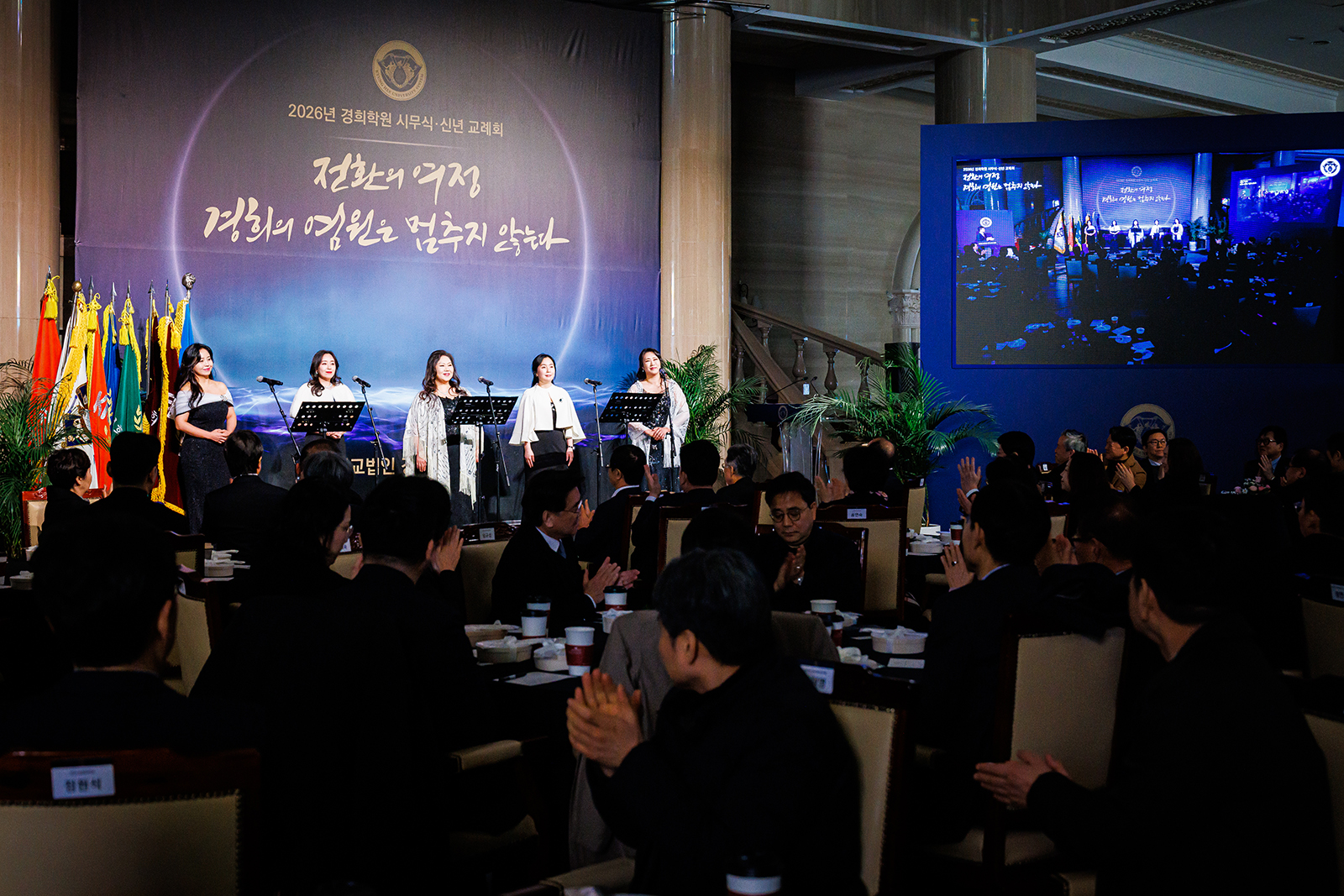
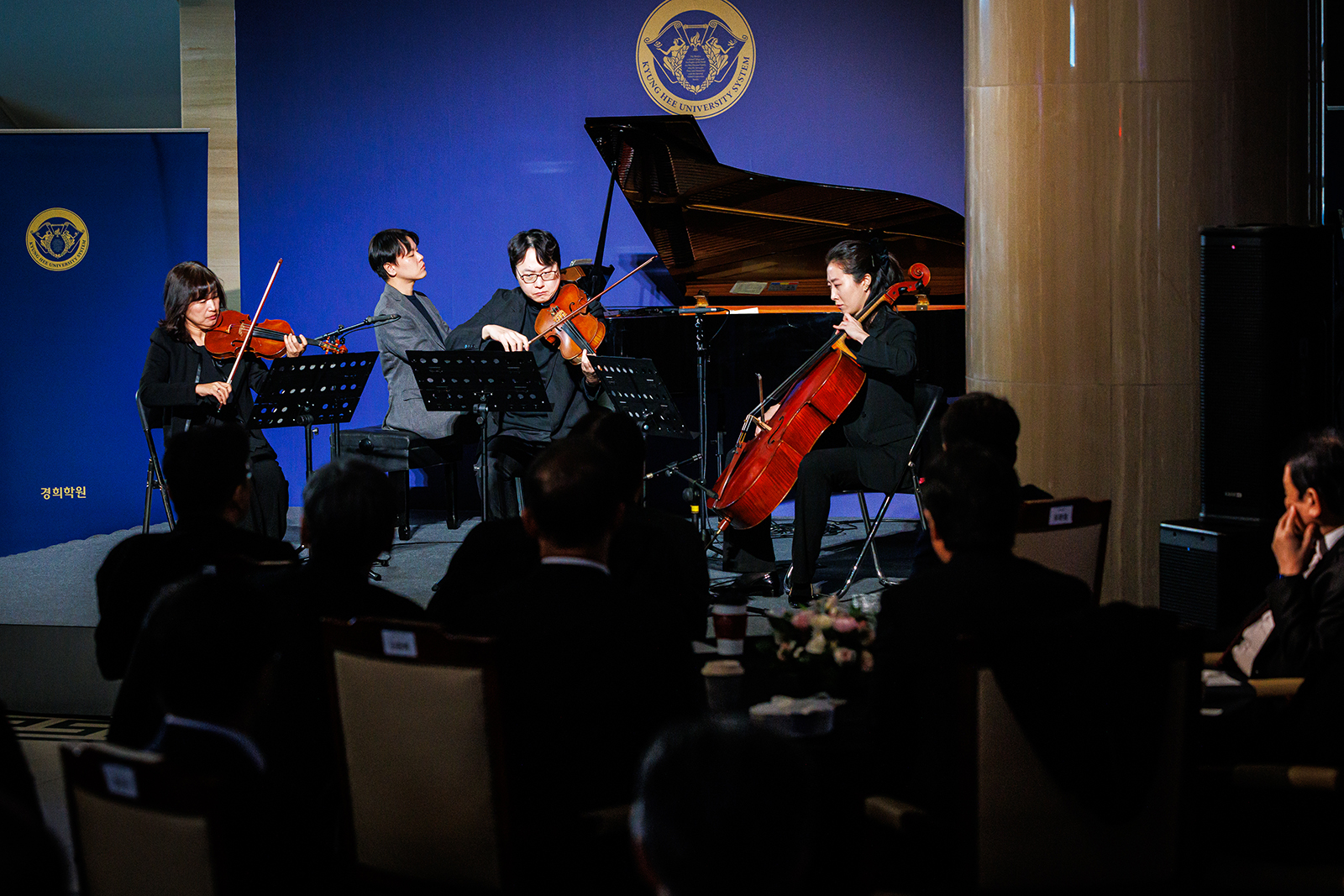
Following the address, the Kyung Hee University College of Music presented two celebratory performances. The first piece was the second movement of Beethoven’s Piano Sonata No 8, “Pathétique.” This work expresses the inner peace and noble humanity that Beethoven never abandoned despite his hardships. It resonated deeply with Kyung Hee’s founding spirit, which has tirelessly pursued the “Creation of a Civilized World” and “Academe and Peace” in an era of civilizational transition. The second piece was the song “Magnolia Blossom,” which captured the aspiration to achieve a better future. After the ceremony, participants moved to the Cheongwoon Building cafeteria to share a traditional meal of tteokguk (rice cake soup), bringing the 2026 New Year’s Ceremony to a warm conclusion.