header
News
World’s First Identification of the Lifshitz Transition in Topological Semimetals
DATE 2026-02-09 10:49:10.0
- WRITER 학무부총장실
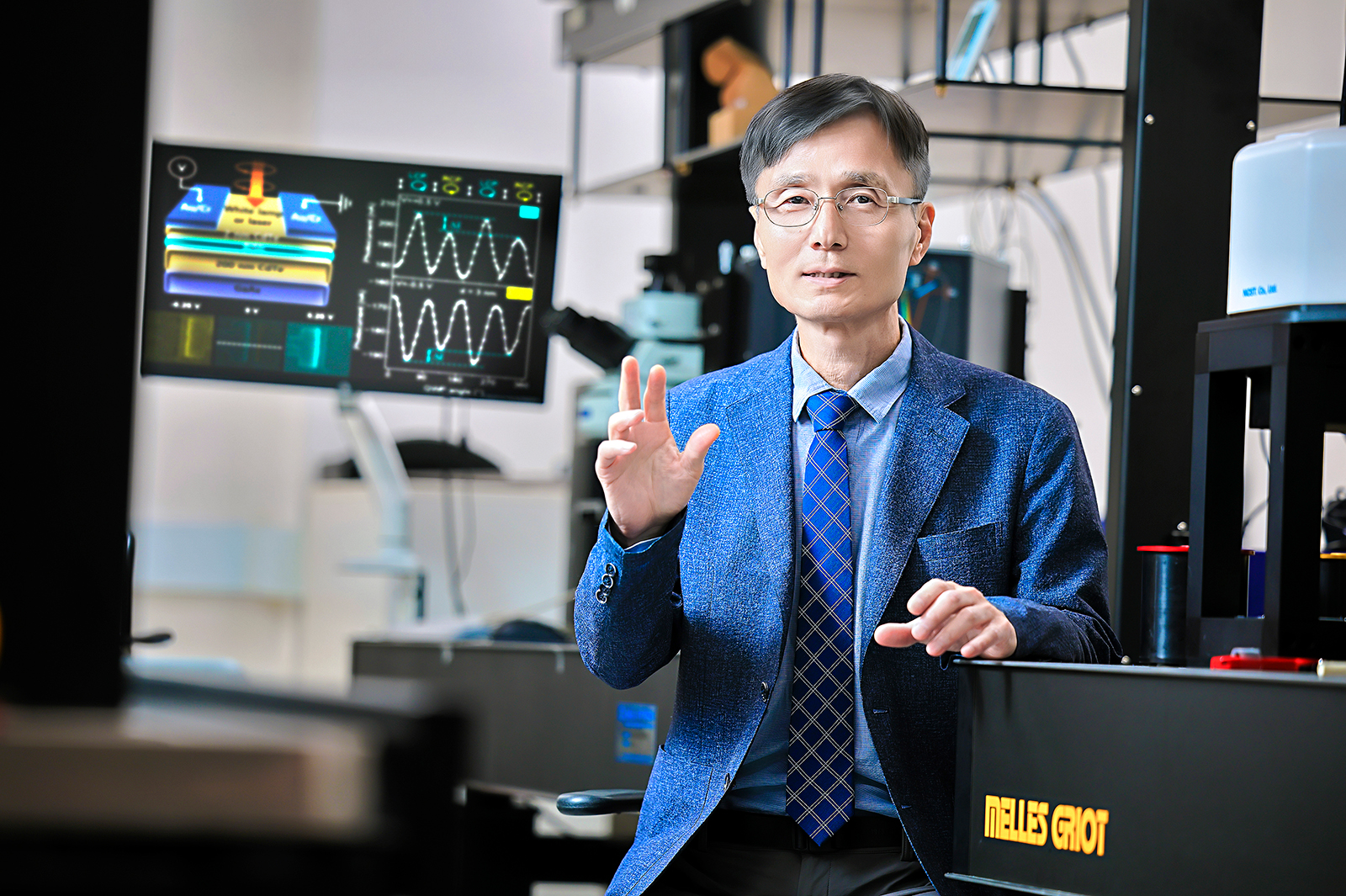
The Research Team of Kohwang Distinguished Professor Suk-Ho Choi, Department of Applied Physics
Experimentally verifying a previously theoretical phenomenon by measuring plasma frequency in topological semimetals
The research team led by Kohwang Distinguished Professor Suk-Ho Choi in the Department of Applied Physics has become the first in the world to identify the principles of the Lifshitz transition by directly measuring plasma frequency in topological semimetals (TSM)*. By demonstrating that plasma oscillation is directly linked to changes in topological electronic structures, the team has introduced a transformative measurement paradigm for the future of quantum materials research.
Discovery that fundamental transformations in material topology are possible through precise thickness control
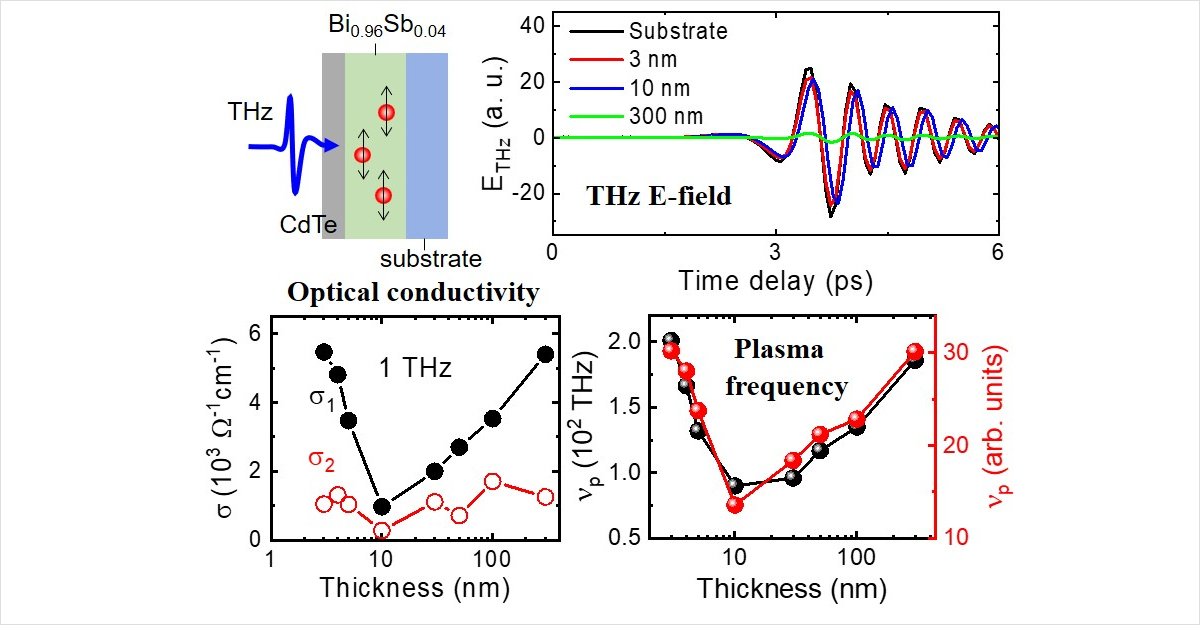
The Lifshitz transition occurs when the electronic band structure within a material shifts, causing a topological change in the Fermi surface. This core concept is applied broadly across quantum materials research—including magnets, superconductors, and topological matter—as well as in high-energy physics and black hole studies. Until now, the Lifshitz transition had only been observed indirectly, with its physical reality remaining unverified. It remains a critical fundamental physical phenomenon with wide-reaching implications for our understanding of the quantum world.Professor Choi’s research team precisely grew thin films of TSM ranging from 2 to 300 nm and analyzed electron behavior using optical measurements in the terahertz range. They observed that when the film reached a critical thickness of 10 nm, the plasma frequency hit its lowest point, coinciding with a minimum in charge density. This marked the world’s first optical experimental proof of the theoretical prediction that plasma frequency reaches a minimum at the critical point of a Lifshitz transition in topological semimetals.
Beyond experimentally verifying theoretical concepts, this achievement is deeply significant as it establishes a new measurement paradigm. By observing topological phase transitions through collective optical responses rather than traditional methods, the research team has successfully mapped a logical trajectory: the control of topological transitions leads to the implementation of new topological states, which ultimately enables the demonstration of fundamental quantum effects.
“We have established the foundation to move toward practical applications for topological semimetals, which has garnered significant attention as next-generation materials following graphene,” explained Professor Choi. He noted that two-dimensional topological semimetals offer distinct advantages for device design—specifically in terms of miniaturization and integration—compared to their three-dimensional counterparts. These findings are expected to accelerate the realization of future technologies, including the development of high-performance electronic and optoelectronic devices, as well as the diagnosis, control, and design of core materials for quantum computing.
This research was conducted with support from the Mid-career Researcher Program funded by the Ministry of Science and ICT and the National Research Foundation of Korea. The project involved a collaborative effort between the university research team and researchers from the Gwangju Institute of Science and Technology (GIST), Sungkyunkwan University, and the Australian National University. The results were published in the December issue of the world-renowned academic journal Materials Today Physics (Impact Factor: 9.7).
*Topological semimetal (TSM): a class of materials characterized by electronic structures and electron dynamics that fundamentally differ from those of conventional metals or semiconductors. In these materials, electrons do not move symmetrically; instead, they exhibit directional movement and demonstrate unique responses to external magnetic fields, providing a critical platform for investigating diverse quantum phenomena.