header
News
On Becoming a Physician-Scientist: Insights from a World-Renowned Kyung Hee Alum
DATE 2026-01-26 16:22:19.0
- WRITER 학무부총장실

Kyung Hee Eminent Scholar Professor Ik-Kyung Jang of Harvard Medical School led Mentoring Program for Outstanding Undergraduate Research Students"
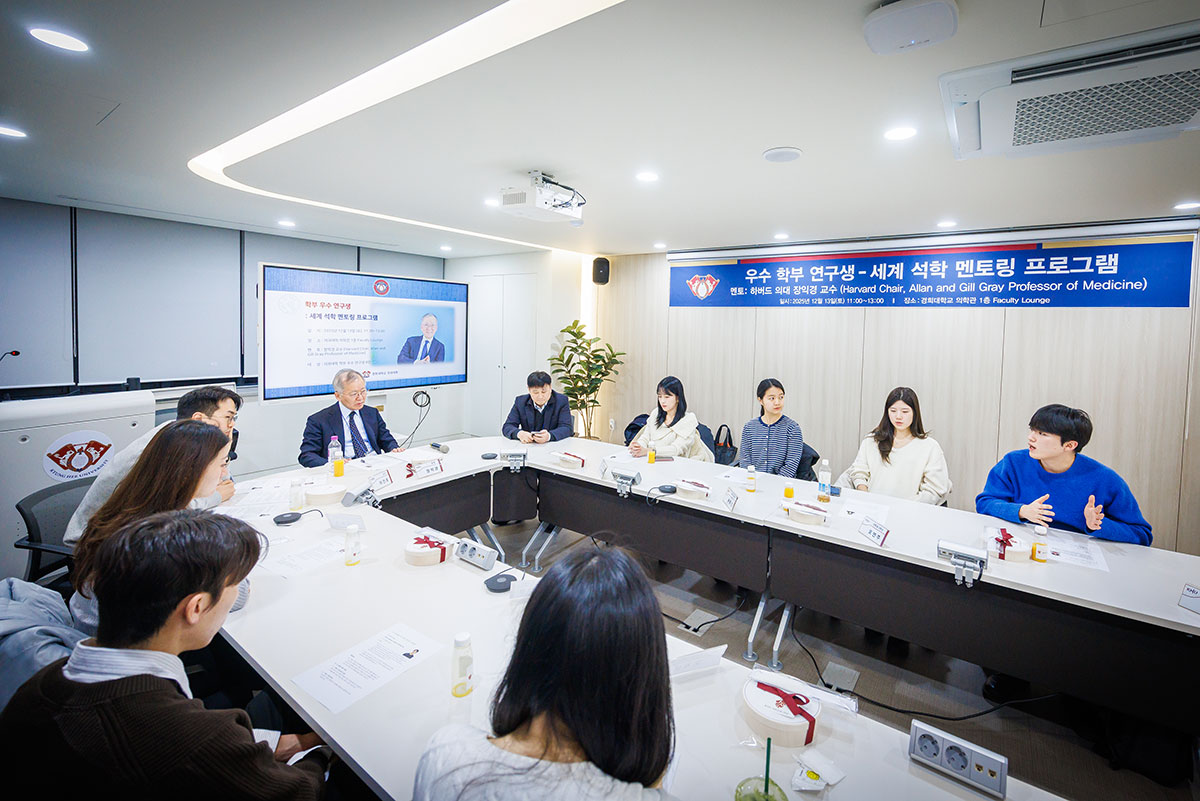
On December 13th, 2025, the College of Medicine hosted the World-Renowned Scholar Mentoring Program for Outstanding Undergraduate Research Students in the Faculty Lounge of the Medical Building. The program welcomed Professor Ik-Kyung Jang, Eminent Scholar at the College of Medicine and Allan and Gill Gray Professor of Medicine at Harvard Medical School.
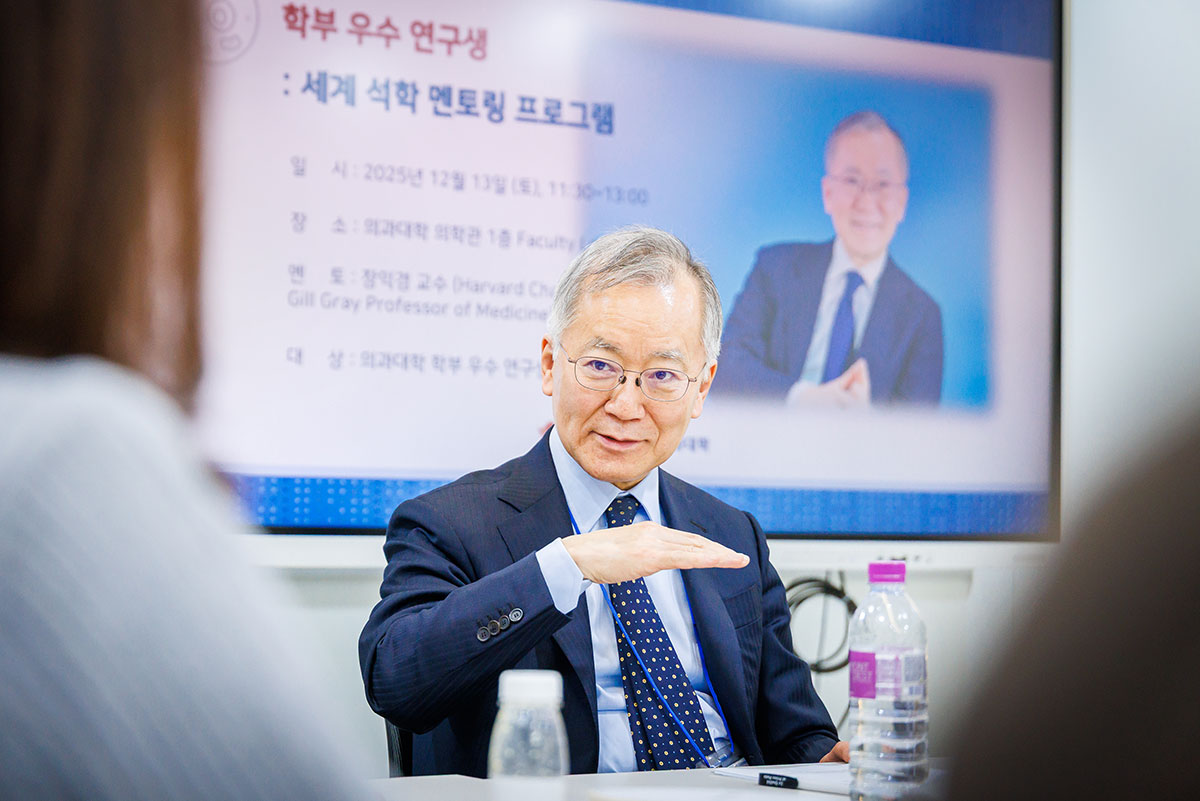
Professor Ik-Kyung Jang is a chaired professor at Harvard Medical School and a practicing cardiologist at Massachusetts General Hospital (MGH). He is internationally recognized for pioneering advances in cardiovascular imaging technology, particularly optical coherence tomography (OCT). He is also widely credited with helping establish the "Bench to Bedside" paradigm, a research philosophy that forges a continuous and reciprocal pathway between laboratory discovery and clinical practice.
The mentoring session brought together Professors Ik-Kyung Jang, Young Buhm Huh (Dean, the College of Medicine), Tong In Oh, and Jinho Lee. Eight outstanding undergraduate research students selected from each lab also joined the expert panel. These students have already distinguished themselves as first authors in leading international medical journals, including The Journal of the American Medical Association (JAMA), Nature Medicine, European Heart Journal, Circulation, and the Lancet Respiratory Medicine, drawing attention from the global academic community.
During the mentoring session, the eight outstanding young students posed thoughtful and candid questions to the mentoring panel, who were also their senior Kyung Hee alums. Students sought advice on the many choices they face as emerging physician-scientists, including how to balance clinical duties and research, how to navigate specialization versus interdisciplinary convergence, and how to approach overseas research and training opportunities.
Rather than offering a single prescriptive "right answer," Professor Jang focused on the importance of context in shaping each individual choice. He emphasized the value of identifying a research question that invites sustained intellectual engagement and depth. He also explained that delving deeply into a single field and gaining experience across diverse disciplines are not opposing paths but natural, complementary stages that may unfold at different points in one’s career.
Professor Jang also offered practical insights into bridging clinical experience and scientific inquiry. He explained, "A physician's clinical experience and understanding of patient data can serve as a starting point for meaningful research. The challenge lies in learning how to translate these clinical observations into well-formulated research questions."
Professor Jang encouraged students to resist haste or the fear of missing out, advising them to pursue both research and clinical training at their own pace. He said, "The path to becoming a physician-scientist is not about who produces great results in a short period of time. It is a lifelong journey shaped by accumulated choices and experiences." His considerate advice carried a hope that the students would never lose sight of their inner questions that first drew them to medicine and science.
Dean Young Buhm Huh reflected on the significance of the session, saying, "This mentoring program offered students an opportunity to reflect collectively on the kind of researchers and doctors they aspire to become. The College of Medicine will continue to support the cultivation of physician-scientists who bridge research and clinical practice, starting at the undergraduate level."