header
News
Turning Marine Waste into Material, Light, and Form: Crafted from Recycled Oyster Shells
DATE 2025-12-29 11:16:45.0
- WRITER 학무부총장실

OOZZ, a student startup team from the Department of Industrial Design, has won the Grand Prize at the Young Designer Exhibition of the DDP Design Fair, hosted by the Seoul Design Foundation, for a series of living-space objects developed through material-driven sustainable design
Comprised of Students Chansol Choi, Donghwa Jeong, Geon Park, and Yujin Lee, OOZZ was launched in 2024 with support from Korea’s Preliminary Startup Package program for young entrepreneurs. Since its founding, the team has focused on material-driven design rooted in environmental responsibility, presenting its work at major design exhibitions including the Seoul Design Fair and design fairs in Tokyo.
This year, OOZZ collaborated with Professor Youbin Kim of the Department of Industrial Design to develop SOLEIL, a living-space object brand that treats recycled material not as an alternative, but as a primary design condition. The project was carried out through an industry–academia partnership with GreenOceans, a startup that developed MikaOceans, a water-soluble resin derived from discarded oyster shells. By combining MikaOceans with biochar-infused concrete, OOZZ created a collection of four living-space objects: three lamps and a side table. Rather than concealing the material’s origin, the designs foreground its mineral texture and surface irregularities, allowing the physical residue of marine waste to remain visible as a defining visual element.
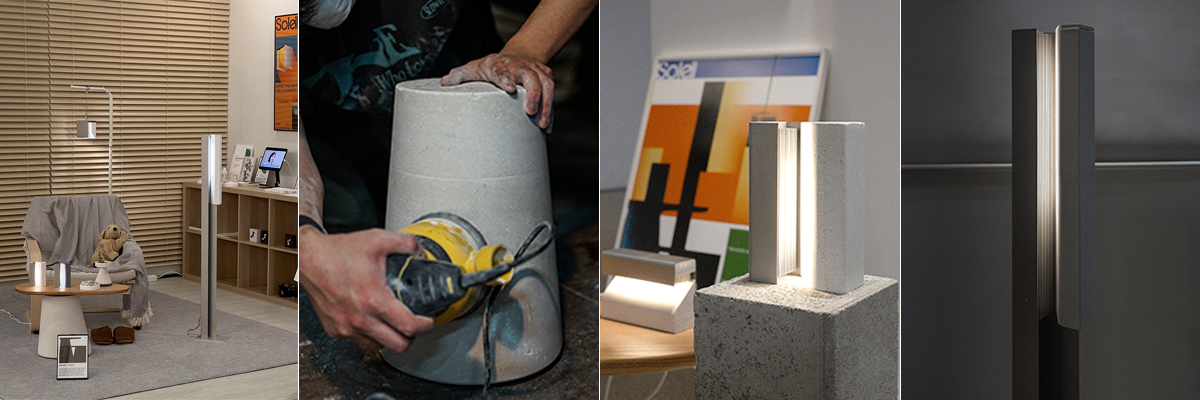
Soleil: a living-space object brand defined by unique recycled material
The DDP Design Fair University Collaboration Program brings together design students and domestic industry partners to develop and exhibit fully realized products. Finalists are selected through evaluations by experts, peers, and the general public at the Young Designer Exhibition. Among 19 university teams from the Seoul metropolitan area, OOZZ received the highest overall evaluation.
Under Professor Kim’s guidance, OOZZ developed four products—three lamps and a side table—drawing on modernist architectural references and the structural qualities of oyster shells. The team explored reduced forms, vertical compositions, and controlled apertures, focusing on how material behavior could inform both form and function. Through repeated experimentation with material combinations and fabrication methods, OOZZ strengthened not only its design sensibility but also its technical understanding of real-world production constraints. These efforts led to a material-related patent application and the publication of academic research—steps that helped strengthen understanding of, and confidence in, eco-friendly materials.
The SOLEIL brand draws from the architectural concept of brise-soleil, a façade-based shading system that redirects incoming sunlight to improve thermal comfort. Reinterpreting this architectural logic at the scale of domestic products, the team employed controlled light paths and carefully calibrated surface depth. The products were refined through accumulated lighting data and ongoing dialogue with mentors and industry experts.
Toward credible, material-based sustainability
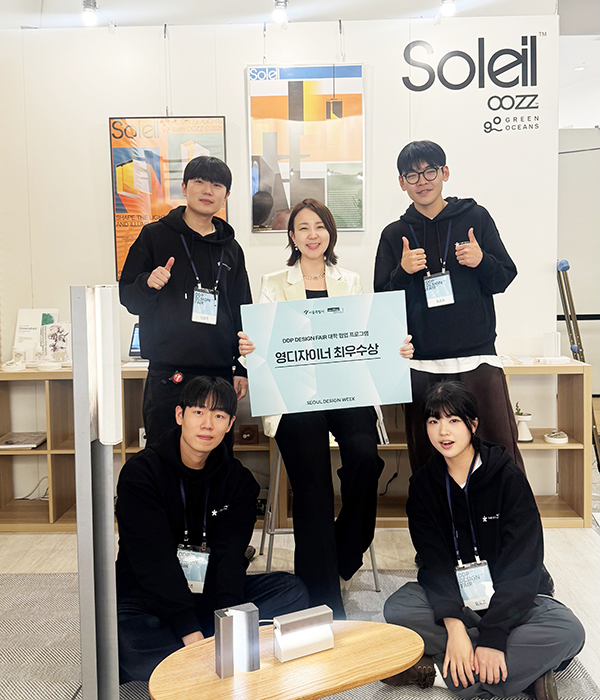
OOZZ’s long-term goal is to expand the everyday use of sustainable materials by establishing their design credibility. “As eco-friendly materials continue to diversify, designers play a key role in shaping how they are perceived,” said Student Chansol Choi. “When the inherent characteristics of these materials are properly understood and applied, public perception can shift naturally. OOZZ intends to contribute at a critical point in that process.”
Professor Youbin Kim emphasized the broader significance of the project. “As ESG and the SDGs become central social agendas, sustainable design education is increasingly important,” she said. “SOLEIL is the result of practice-oriented education combined with students’ commitment. It demonstrates how design can translate social values into tangible form.”