header
News
Solving a Longstanding Bottleneck in Hybrid Rice Production
DATE 2025-12-29 11:15:51.0
- WRITER 학무부총장실
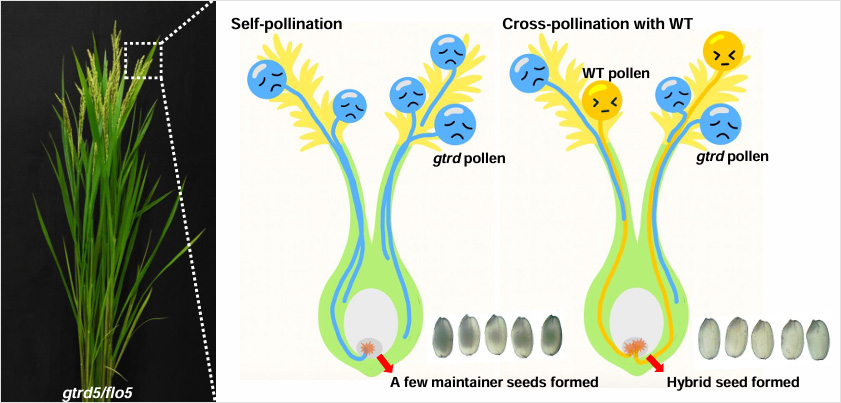
A research team led by Professor Ki-Hong Jung of the Graduate School of Green-Bio Science has developed a new hybrid rice production platform that precisely modulates self-pollination to enhance fertilization by external pollen
Rice, a representative self-pollinating crop, exhibits a strong reproductive bias toward self-fertilization, as its own pollen typically reaches the stigma well before external pollen. This intrinsic characteristic has long posed a structural challenge to the production of hybrid rice seeds, which rely on cross-pollination between different varieties to enhance yield and resilience. To overcome this limitation, male-sterile rice lines—lacking functional pollen—have been widely adopted in hybrid seed production. However, conventional male-sterility systems suffer from inherent instability, making large-scale and consistent seed production difficult under variable environmental conditions.

Reengineering hybrid seed production: precision control of self-pollination and visual seed selection
To address this challenge at its root, Professor Jung’s team introduced a fundamentally different approach to hybrid rice production. Using CRISPR/Cas9 genome-editing technology, the team generated rice lines with partial male sterility by targeting genes essential for pollen tube elongation. This strategy reduces self-fertilization without completely eliminating male function, allowing external pollen to fertilize more effectively. In parallel, the team incorporated a floury endosperm (FLO5) mutation, enabling hybrid and self-pollinated seeds to be readily distinguished by seed color.
This two-line hybrid platform achieved a high proportion of hybrid seed production while remaining stable across diverse environmental conditions, effectively overcoming the limitations of conventional photoperiod- and thermosensitive male-sterile systems. By eliminating reliance on environmentally sensitive maintenance lines and simplifying seed selection through visual markers, the system substantially improves production efficiency and practical applicability. Importantly, the removal of CRISPR/Cas9 components in subsequent generations allows for the establishment of non-transgenic lines, providing a solid foundation for commercialization and regulatory acceptance.

A new paradigm for the global seed industry
Professor Jung emphasized that, despite their high yield and disease resistance, hybrid rice varieties have not fully realized their potential due to the technical complexity of seed production. “Conventional approaches rely on rigid systems that are difficult to manage at scale,” he said. “By precisely modulating self-pollination, our approach creates conditions in which external pollen can fertilize naturally, representing a fundamentally different strategy from existing technologies.” He added that the integration of a visual marker system—allowing hybrid seeds to be identified by color alone—addresses one of the most persistent bottlenecks in industrial seed production. “This platform has strong potential to evolve into a broadly applicable hybrid seed production system across diverse crop species.” Student Su-Kyoung Lee, a doctoral student at the Graduate School of Green-Bio Science and first author of the study, highlighted the system’s extensibility. “The platform is not limited to rice,” she noted. “Because it is designed around core reproductive mechanisms shared by self-pollinating crops, it can be readily applied to barley, wheat, soybeans, and other major crops.” She added that widespread adoption could lead to tangible improvements in both domestic and global food production systems.
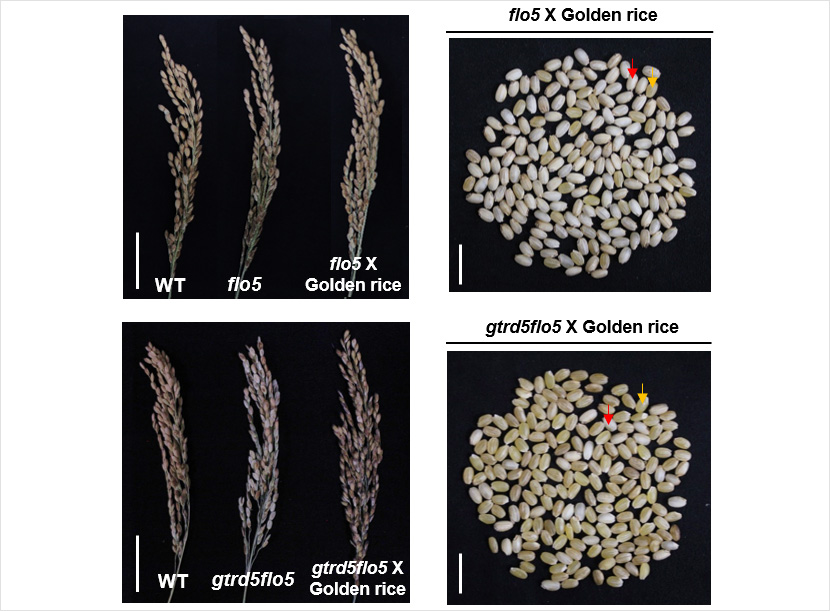
The platform developed by the research team is expected to generate wide-ranging benefits across the agricultural sector, including reduced hybrid seed production costs, higher productivity, and simplified breeding workflows. At a time when climate change is placing increasing pressure on global food systems, the study offers a promising foundation for more stable and scalable seed production. The findings were published online on November 6, 2025, in Plant Biotechnology Journal (IF=10.5) under the title, “Developing an Efficient System for Hybrid Rice Seed Production Using Partial Male Sterility.”