header
News
Kyung Hee Doctoral Research Integrated into Latest U.S. Nuclear Safety Code Update
DATE 2025-12-29 11:14:26.0
- WRITER 학무부총장실

Research conducted by Student In Gyu Chang, a doctoral student in the Department of Nuclear Engineering, has been officially integrated into the latest revisions to NRCDose3 v1.15, a core regulatory radiation dose assessment code used by the U.S. Nuclear Regulatory Commission (NRC)
NRCDose3 is a widely referenced safety benchmark for assessing radiation doses to nearby residents resulting from radioactive effluents released from nuclear power plants. In the United States, it is applied during the nuclear power plant licensing process and is also used internationally by research institutions and universities for educational and research purposes. Similar dose assessment codes are operated in Korea.
Identifying structural limitations and proposing a new dose assessment code
Student Chang identified a structural limitation in NRCDose3: its insufficient accounting for dietary patterns specific to Korea. To address this issue, he independently developed the KHU Code, a dose assessment code based on the NRCDose3 methodology but adapted to reflect domestic conditions. Using the new code, he conducted radiation dose assessments for residents living near nuclear power plants in Korea.
As a result, Student Chang found that several key input parameters used in NRCDose3 deviated substantially from actual reference values, with discrepancies ranging from –69% to +39%. In total, five errors were identified, all of which affected the overall calculation process. Among them, the largest discrepancies appeared in dose assessments for carbon-14 (¹⁴C), a major radionuclide released in gaseous form from nuclear power plants and a significant contributor to public radiation exposure. The deviation was most pronounced in the one-year-old age group, where dietary intake assumptions play a critical role in dose estimation.
If NRCDose3 had been applied directly to nuclear safety assessments in Korea, it could have resulted in an underestimation of radiation doses to the public. In practice, however, this issue did not arise, as Korea applies a separate dose assessment code rather than using the U.S.-developed NRCDose3.
Cited by the NRC as the basis for code revisions
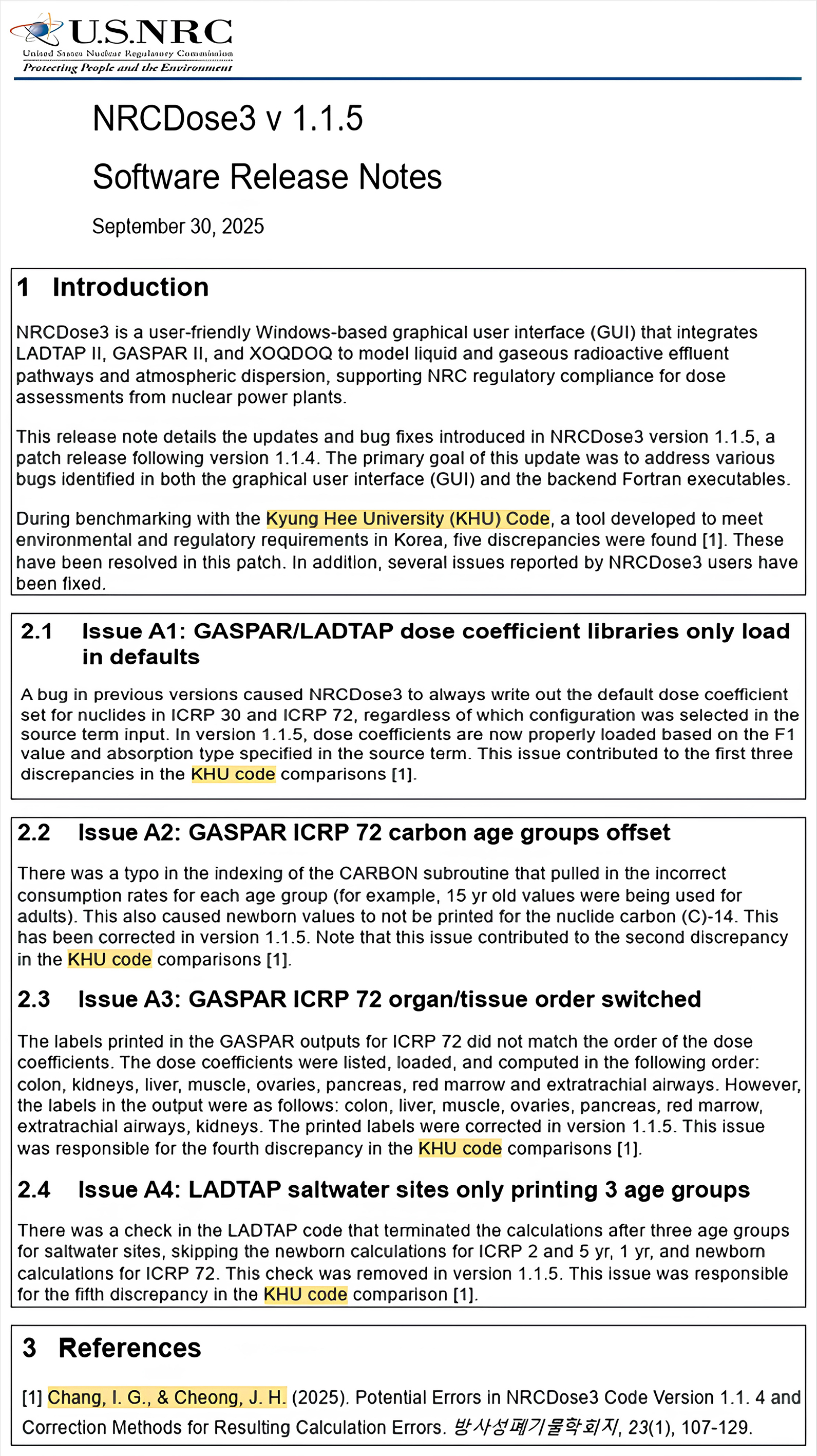
The study was first published in March in the Journal of Nuclear Fuel Cycle and Waste Technology under the title, “Potential Errors in NRCDose3 Code Version 1.1.4 and Correction Methods for Resulting Calculation Errors.” In September, the U.S. Nuclear Regulatory Commission cited the paper in an official report, identifying it as the basis for correcting inconsistencies in the NRCDose3 code. All five discrepancies documented in the study were subsequently revised and incorporated into Version 1.1.5 of the code, with the NRC report explicitly acknowledging that the findings originated from research conducted at Kyung Hee. This citation formally recognized the research team’s contribution to improving the reliability and accuracy of a core computational tool used in nuclear power plant licensing and safety assessments. The process concluded on December 30, 2025, with the publication of an official notice in the Journal of Nuclear Fuel Cycle and Waste Technology announcing the correction of the five identified errors under the title, “Resolution of NRCDose3 Version 1.1.4 Errors in Version 1.1.5.”
Kyung Hee is the only university in Korea to operate an educational nuclear reactor, AGN-210K, and continues to play a leading role in advanced nuclear research and workforce training, including studies on small modular reactors (SMRs). Professor Jae Hak Cheong of the Department of Nuclear Engineering, who supervised the research, noted that the outcome reflects international recognition of Kyung Hee’s research capabilities by a leading global nuclear regulatory authority. Student Chang added that he was encouraged by the opportunity to directly contribute to improving the accuracy of a core code used in nuclear licensing and safety evaluations.